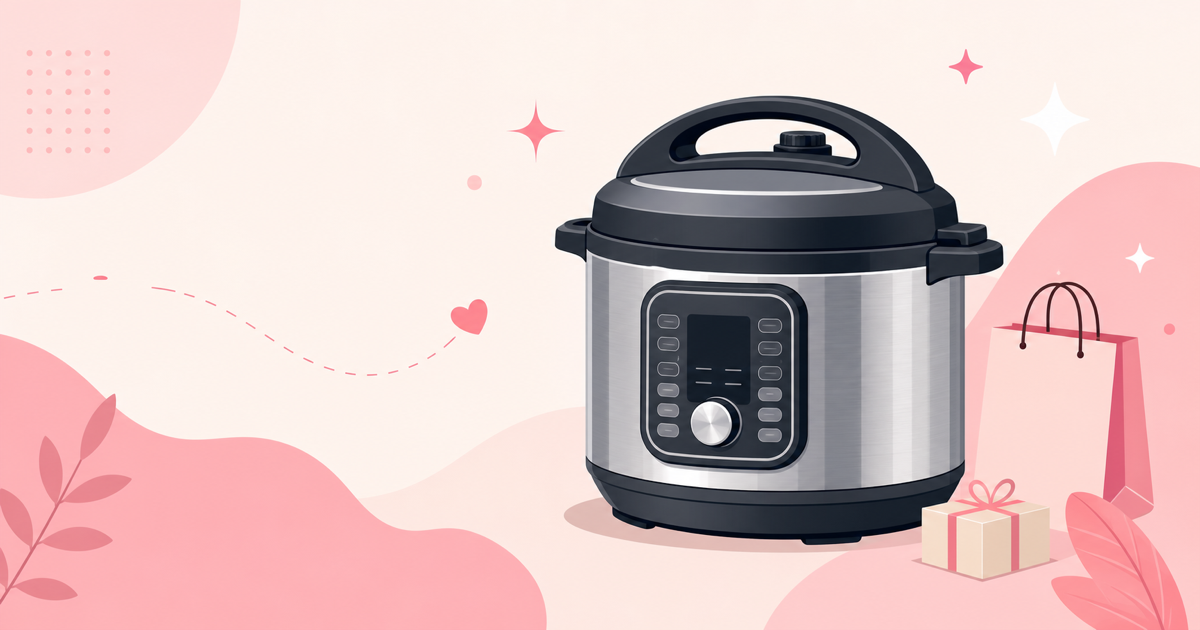
How to Choose an Electric Pressure Cooker: 5 Key Decision Criteria
"I bought one, but I stopped using it" — that's a common regret with electric pressure cookers.
Most of the time, the problem comes down to picking capacity and features that don't match how the household actually cooks.
The right model varies a lot depending on how often you cook, how many dishes you make, and where you'll store it.
Here are the 5 criteria you should check before buying, including how to read the specs.
1. Choose capacity based on "household size + leftovers you want to make"
Here's a rough guide:
- Living alone: around 2L
- 2-3 person household: around 3L
- 4+ people: 4L or more
That said, this guide doesn't assume you'll fill it to the brim every time.
Because a pressure cooker needs to be sealed with ingredients and liquid inside, the actual usable capacity is typically only about 60-80% of the listed volume.
If you often cook dishes you make in bulk, like curry or simmered meat and potatoes, sizing up one level helps you avoid running out of room mid-cook.
On the other hand, larger capacity means a bigger, heavier unit, so it's worth measuring your storage space and checking how easy it'll be to get in and out before you buy.
2. Number of auto menus, and what they actually automate
What matters more than the "number" of auto menu options is whether steps beyond pressure cooking itself are automated too.
- Pressure cooking only: the machine manages pressurizing and depressurizing, but sautéing and prep are manual
- Fully automatic (with a stirring function): once ingredients are added, everything from sautéing to simmering happens hands-free
If you want to make stir-fries or fried rice too, you'll need the latter type.
Models with an LCD navigation screen also walk you through the cooking steps on-screen, so you don't need to keep a recipe book open while you cook.
3. Pressure level (kPa) and how fast it pressurizes
A pressure cooker's pressure output is measured in kPa (kilopascals) — the higher the number, the more easily pressure reaches the core of the ingredients, enabling shorter cook times.
Standard electric pressure cookers run around 60-90 kPa, while high-pressure models can exceed 90 kPa.
If you frequently cook dishes that need long, thorough cooking — like braised pork belly or bone-in meat — a high-pressure model will give you a more noticeable time savings.
4. Features beyond pressure cooking (waterless cooking, low-temperature cooking, rice cooking)
Recent models aren't limited to pressure cooking — they're becoming increasingly multi-functional.
- Waterless cooking: simmers using only the moisture from the vegetables themselves, concentrating the ingredients' natural flavor
- Low-temperature cooking: holds a steady temperature, useful for dishes like roast beef
- Rice cooking / fermentation: can double as a rice cooker or fermentation device
A single unit that covers multiple cooking appliances means fewer devices cluttering your kitchen. That said, more features generally means a higher price point, so it's worth narrowing down which functions you'll actually use before buying.
5. Ease of cleaning (how many parts come apart)
For an appliance you'll use daily, how easy it is to clean has a big impact on whether you'll keep using it.
Check these three points:
- Can the inner lid and gasket be removed and washed thoroughly?
- Is the inner pot made of a stain-resistant material, like a fluorine coating?
- Are small parts like the steam vent and safety valve easy to clean?
Models with more individual parts tend to stay more hygienic, but keep in mind that also means more pieces to wash — it's a trade-off worth weighing.
Spec Comparison Table
| Product | Capacity | Pressure/Heating Method | Stirring Function |
|---|---|---|---|
| Iris Ohyama PMPC-MA4 | 4L | Standard pressure | No |
| Tefal Cook4Me 3L | 3L | Standard pressure, LCD navigation | No |
| Panasonic Auto Cooker Bistro NF-AC1000 | – | IH heating | Yes (bottom-of-pot stirring) |
| Siroca Ouchi Chef PRO SP-2DP251 | – | High pressure 95kPa | No |
| Zojirushi Automatic Pressure IH Pot EL-MB30 | 3L | IH heating, automatic pressure control | No |
| Cooking Pro V2 3.2L | 3.2L | Standard pressure | No |
Top 6 Electric Pressure Cooker Picks
Best value: Iris Ohyama Electric Pressure Cooker 4L PMPC-MA4
This model comes with 80 auto menu options at an entry-level price point. Its 2-in-1 design also works as a grill pot, so you can bring it straight from cooking to the table for hot pot-style meals.
Strengths
- A wide range of auto menus means you don't need a recipe book
- 2-in-1 design also works for tabletop hot pot
- Large 4L capacity, well suited to batch cooking
Points to note
- No stirring function, so stir-fries need to be done manually
- Larger capacity means a bigger unit overall
Best for
Anyone trying an electric pressure cooker for the first time who wants to keep costs down.🛒 Check the price →
Best for speed: Tefal Cook4Me 3L
The LCD screen walks you through each cooking step, so there's no need to follow along with a recipe. It's known for fast preheating and pressurizing, which helps cut down wait time even on busy weeknights.
Strengths
- LCD navigation makes it easy for cooking beginners to follow along
- Fast preheating and pressurizing
- A large built-in recipe library
Points to note
- No stirring function, so sautéing steps need to be done separately
- Takes a bit of time to get used to the navigation controls
Best for
Anyone unsure about cooking steps who wants to be guided through the process on-screen.🛒 Check the price →
The ultimate all-in-one: Panasonic Auto Cooker Bistro NF-AC1000
This is one of the few models with a bottom-of-pot stirring function, letting it automatically cook dishes that include sautéing steps, like fried rice or twice-cooked pork. IH heating also delivers precise temperature control.
Strengths
- Stirring function enables hands-free cooking even for stir-fried dishes
- IH heating provides precise temperature control
- A broad range of supported menus
Points to note
- Priced at the higher end
- The unit and accessories are on the larger side, so it needs more storage space
Best for
Anyone who wants completely hands-off cooking, including stir-fry steps.🛒 Check the price →
Best for solo living: Siroca Ouchi Chef PRO SP-2DP251
With 95kPa of high pressure, it quickly reaches the core of root vegetables and meat. Its compact, quiet design also makes it easy to fit into a studio apartment kitchen.
Strengths
- 95kPa high pressure shortens cooking time
- Compact size fits easily into a solo-living kitchen
- Runs quietly
Points to note
- Smaller capacity isn't ideal for batch cooking
- No stirring function
Best for
Anyone cooking for one or two who wants quick meals in a space-saving unit.🛒 Check the price →
Best for simmered dishes: Zojirushi Automatic Pressure IH Pot EL-MB30
It automatically coordinates pressure levels with IH heating power to produce simmered dishes that are thoroughly infused with flavor. It also supports cooking two dishes at once using dedicated pouches.
Strengths
- IH-linked control helps flavor soak in consistently
- Pouch cooking lets you make two dishes at the same time
- Known for consistently reliable results among pressure cookers
Points to note
- No stirring function, so stir-fries aren't supported
- Pouch cooking requires purchasing dedicated pouches
Best for
Anyone who prioritizes the quality of simmered dishes like braised pork belly.🛒 Check the price →
The 8-in-1 multi-cooker: Cooking Pro V2 3.2L
A long-running best-seller that handles 8 functions: pressure cooking, rice cooking, waterless cooking, steaming, slow cooking, reheating, simmering, and sautéing. Its simple control panel makes it easy for the whole family to use every day.
Strengths
- Versatile enough to cover 8 cooking modes in one unit
- Simple controls that the whole family can use easily
- Also supports waterless and low-temperature cooking
Points to note
- No stirring function, so stir-fries require manual operation
- The number of buttons is a bit higher due to the many functions
Best for
Anyone who wants to consolidate multiple kitchen appliances, like a rice cooker and steamer, into one.
Choosing by Use Case
- Want a first unit that keeps costs down: Iris Ohyama PMPC-MA4
- Not confident cooking and want step-by-step guidance: Tefal Cook4Me
- Want stir-fries fully automated too: Panasonic Auto Cooker Bistro
- Living alone and prioritizing space and speed: Siroca Ouchi Chef PRO
- Prioritizing the quality of simmered dishes: Zojirushi Automatic Pressure IH Pot
- Want to consolidate kitchen appliances into one: Cooking Pro V2
FAQ
Q. How is an electric pressure cooker different from a regular (stovetop) pressure cooker?
With a stovetop model, you need to monitor pressurizing and depressurizing and adjust the heat manually. The key difference with an electric pressure cooker is that sensors automatically control pressure and temperature, so cooking can continue even if you step away.
Q. Do pressure cookers wear out quickly with daily use?
Consumable parts like the gasket do wear down with frequent use, but most models let you purchase a replacement gasket on its own. With regular cleaning and part replacement, they can hold up well to everyday use over the long term.
Q. Can I still make stir-fried dishes without a stirring function?
Yes, you can still sauté manually as a prep step before pressure cooking. The difference with models that have a stirring function is that the machine handles this sautéing step automatically — your choice depends on whether you want to eliminate that manual effort entirely.
Q. How often should I wash the inner pot and other parts?
The inner pot, inner lid, and gasket should generally be washed after every use. Even if the steam vent and safety valve don't look dirty, disassembling and checking them about once a month helps keep the unit hygienic.
Q. Is a higher pressure level (kPa) always better?
Higher pressure does shorten cooking time, but it can also cause some ingredients to break down more easily. If speed is your priority, a high-pressure model is a good fit; if you often cook dishes where you want to preserve the texture of the ingredients, a standard-pressure model is better suited.
Summary
Here are the 5 criteria to check when choosing an electric pressure cooker:
If you want to keep costs down, Iris Ohyama is a strong candidate; if you want step-by-step guidance, Tefal; and if you want stir-fries fully automated too, Panasonic Bistro is worth considering.
For solo living, the space-saving Siroca is a good fit; for the best simmered dishes, Zojirushi; and if you want to consolidate your kitchen appliances, Cooking Pro V2 fits the bill.
Compare models against these 5 criteria based on how often you cook and the types of dishes you want to make, and choose the one that fits your kitchen best.


![Pressure Cooker Comparison [2026 Edition] | Pro-Picked Rankings for the Best Models](/images/eyecatch/articles/pressure-cooker-comparison-2026.png)
![[2026 Latest] Top 5 Yogurt Maker Rankings|Complete Comparison Guide](/images/eyecatch/articles/yogurt-maker-ranking-top5.png)
![[2026 Latest] Top 5 Bento Box Rankings|A Thorough Comparison](/images/eyecatch/articles/bento-box-recommended-ranking-top5.png)
![[2026 Latest] Cutting Board Comparison: A Thorough Test of Wood, Plastic, and Antibacterial Materials](/images/eyecatch/articles/cutting-board-comparison-2026.png)