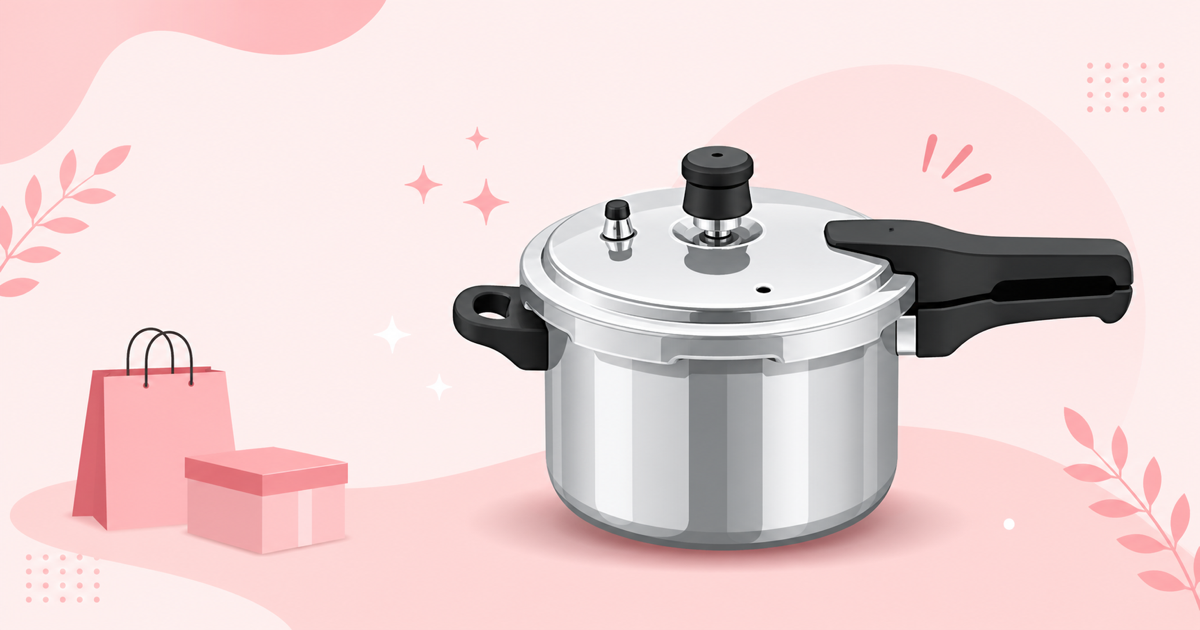

When you start shopping for a pressure cooker, most people get stuck in the same place. Should you go with a stovetop or an electric model? What actually changes between a 3L and a 5L pot? Is there really a difference between a budget model and one that costs several times more? Product listings usually only tell you the capacity and compatible heat source, leaving the real question — "how are these actually different?" — unanswered.
The good news is that pressure cooker performance differences can be explained through a fairly clear set of criteria: the cooker's operating pressure (kPa), the number of pressure settings, the lid-locking mechanism, and the availability of replacement parts like gaskets. Once you understand these four factors, you can look at any store shelf or Amazon listing and judge whether a model fits your cooking style.
This article first breaks down how to choose a pressure cooker into concrete criteria, then reviews seven stovetop and electric models in detail — strengths as well as drawbacks worth knowing about. At the end, you'll find conclusions organized by use case ("beginners," "budget-conscious," "serious home cooks," "hands-off cooking"), so by the time you finish reading, you should have your options narrowed down to one or two models.
---
How to Choose a Pressure Cooker | 5 Criteria That Prevent Buyer's Remorse
1. Operating Pressure (kPa) — The Single Most Important Spec for Time Savings
The first thing to check in a pressure cooker's spec sheet isn't capacity — it's operating pressure. Measured in kPa (kilopascals), this figure shows how much pressure the cooker can add above atmospheric pressure.
As a general rule, higher pressure means a higher boiling point inside the pot, which means shorter cooking times.
| Operating Pressure | Approx. Internal Temperature | Best For |
|---|---|---|
| ~60–70 kPa (low pressure) | ~112–115°C | Vegetables, fish, dishes you don't want to fall apart |
| ~80–100 kPa (high pressure) | ~117–120°C | Beef tendon, braised pork belly, dried beans, brown rice |
Most higher-end stovetop models support high pressure up to around 100 kPa, while electric pressure cookers are typically limited to around 70 kPa due to their design. This is why electric models are often described as "convenient, but a step behind stovetop models when it comes to cutting cooking time for tough ingredients." If you frequently cook dried beans or beef tendon, look for a high-pressure model. If your cooking is mostly everyday vegetables and prep work, low pressure is plenty.
2. Stovetop vs. Electric — Two Very Different Kinds of Effort
Even though both are called "pressure cookers," it's more accurate to think of these as two different kinds of appliances.
- Stovetop (gas/IH): Heats up and reaches pressure quickly, and pressure levels tend to run higher. However, you need to manage the heat yourself — high heat until the pressure weight starts rocking, then lower heat, timing the cook, then removing from heat and releasing pressure.
- Electric: Add ingredients and seasoning, press a button, and pressurizing through depressurizing happens automatically. Many models also offer delayed cooking and keep-warm functions. The trade-off is a longer time to reach pressure, and the unit itself takes up about as much counter space as a rice cooker.
If you don't want to tie up a stovetop burner or want to leave the kitchen while cooking, go electric. If you want to actually shorten cooking time or use the pot for regular simmered dishes too, go stovetop.
3. Capacity — "Usable Capacity" Is About Two-Thirds of the Listed Size
You can't fill a pressure cooker to the brim. For safety, ingredients and liquid should stay at or below two-thirds of the pot's capacity (and at or below one-third for foods that expand, like beans).
That means a 5L pressure cooker really has a usable cooking capacity of about 3.3L. Keep that in mind when sizing for your household:
- 1–2 people: around 3L
- 2–3 people: around 4L
- 4–5 people: 5–6L
- Batch-cooking curry for two days: 5L or more
For electric pressure cookers, the capacity in the product name (e.g., 4L) and the actual "cooking capacity" (how much you can realistically put in) are often listed separately, so always check the cooking capacity figure before buying.
4. Compatible Heat Source and Lid-Opening Mechanism
If you cook on an IH cooktop, you'll need an IH-compatible model with a multi-layer base that includes magnetic stainless steel. Look for "all heat sources" labeling to cover gas, IH, halogen, and radiant cooktops.
The lid-opening mechanism also has a big impact on everyday usability.
- One-touch/lever type: Opens and closes with one hand, and the locked position is easy to identify. Good for beginners.
- Drop-in (slide) lid: Simpler and lighter construction that tends to keep costs down, but takes some practice to align correctly.
5. Safety Features and Replacement Part Availability
A pressure cooker is a pressure vessel, so don't compromise on safety features. At minimum, check for these three:
One thing that's easy to overlook is the availability of replacement gaskets. The rubber gasket is a wearable part that needs replacing every one to two years — once you can no longer get one, the pot has essentially reached the end of its useful life. Whether the manufacturer keeps replacement parts in supply long-term is a critical factor if you plan to use the cooker for a decade. Certification marks (in Japan, SG or PSC marks) are also a useful signal that a model meets recognized safety standards.
---
Spec Comparison Table
| Product | Type | Approx. Capacity | Pressure Settings | Compatible Heat Sources |
|---|---|---|---|---|
| Pearl Metal Quick Eco 3-Layer Base Switchable Pressure Cooker 5L | Stovetop | 5L | Low/High switchable + regular pot mode | Gas, IH |
| T-fal Clipso Arch Excellence 6L | Stovetop | 6L | 2-stage (low/high) | Gas, IH |
| Fissler Vitaquick Plus 6L | Stovetop | 6L | 2-stage + steaming setting | Gas, IH |
| Iris Ohyama Electric Pressure Cooker KPC-MA4 | Electric | ~4L (smaller usable capacity) | Automatic control | Electric only |
| Siroca Electric Pressure Cooker Ouchi Chef SP-4D151 | Electric | ~4L | Automatic control | Electric only |
| WMF Perfect Plus Pressure Cooker 4.5L | Stovetop | 4.5L | 2-stage (low/high) | Gas, IH |
| Panasonic Electric Pressure Cooker SR-MP300 | Electric | ~3L | Automatic control | Electric only |
Specifications may change due to product improvements or manufacturing batches. Please check the manufacturer's official site and the latest product page before purchasing.
---
Top 7 Pressure Cooker Picks
Pearl Metal Quick Eco 3-Layer Base Switchable Pressure Cooker 5L
A stainless-steel stovetop pressure cooker that has long been a staple in the entry-level segment from a domestic manufacturer. Its stainless-aluminum-stainless three-layer base spreads heat evenly and works on IH cooktops too. Its standout feature is a switchable weight that lets you choose "high pressure," "low pressure," or use it as a "regular pot" — so you can pressure-cook and then remove the lid to reduce the sauce, all with one piece of cookware.
Strengths
- Switches between high pressure, low pressure, and regular pot mode for versatile cooking
- 5L capacity suits curry and stew batch cooking, at an entry-level price point
- Made by a domestic manufacturer, so replacement gaskets and other parts are easy to find
Drawbacks
- Uses a drop-in lid, which takes some practice to align correctly at first
- Being stainless steel, the body is somewhat heavy and can be a handful to wash
Best for
Anyone looking for a low-risk first pressure cooker, or households wanting to try out "life with a pressure cooker" before investing in a pricier model.🛒 Check the price →
T-fal Clipso Arch Excellence 6L
One of T-fal's higher-end pressure cooker models, its biggest advantage is a one-touch closing mechanism — just tilt the handle down to lock the lid. On top of a 2-stage low/high pressure setting, it offers recipe-matched mode selection and a clear indicator showing when pressure has fully released. At 6L, it's large enough to cook a stew for 4–5 people in one batch.
Strengths
- One-touch mechanism opens and closes with one hand, with almost no hassle
- Clear pressure indicator and safety lock make it easy for anyone in the family to use
- Lid parts can be disassembled for washing, which helps prevent lingering odors
Drawbacks
- The one-touch mechanism means a more complex design with more lid components
- At 6L (full capacity), it can be too large for small-batch cooking
Best for
People who use their pressure cooker daily and prioritize hassle-free opening and closing above all. Also works well in kitchens shared by the whole family.🛒 Check the price →
Fissler Vitaquick Plus 6L
A serious, professional-grade pressure cooker from a long-established German cookware maker. It offers precise stainless-steel finishing, stepped pressure settings, and controls that let you choose how steam is released. The handle is designed to be removable for storage, and the pot itself is built for long-term durability.
Strengths
- Intuitive pressure switching and steam release make it easy to hit your target doneness
- High-quality stainless steel gauge and welding built to last a decade or more
- Well-supported replacement parts, so gasket swaps keep it running for years
Drawbacks
- Priced at the premium end, a significant investment for a first pressure cooker
- Body has some heft, which can be a burden to wash and move for smaller users
Best for
Anyone who wants a pressure cooker as a "lifetime tool" rather than a disposable appliance. Well suited to serious home cooks who regularly make beef tendon or bean dishes.🛒 Check the price →
Iris Ohyama Electric Pressure Cooker KPC-MA4
A widely chosen entry-level electric pressure cooker. It comes with numerous built-in automatic menus — just add ingredients and select a menu number, and it handles everything from pressurizing to depressurizing on its own. Besides pressure cooking, it offers waterless cooking, low-temperature cooking, and temperature-controlled cooking modes, with a removable inner pot for easy washing.
Strengths
- A large selection of automatic menus lets you make standard dishes without looking up a recipe
- Multiple modes beyond pressure cooking cover a wide range of cooking styles in one unit
- Keep-warm and delayed-start functions make it easy to time meals around when you get home
Drawbacks
- Actual cooking capacity is smaller than the listed capacity, and can feel tight for 4 servings
- Requires preheating time before pressurizing, so it doesn't feel as "quick" as a stovetop model
Best for
Dual-income households who want to leave the kitchen while cooking, or anyone who lacks confidence in their cooking process and wants to rely on automatic menus.🛒 Check the price →
Siroca Electric Pressure Cooker Ouchi Chef SP-4D151
A multi-function model that handles pressure cooking alongside waterless cooking, steaming, rice cooking, slow cooking, and reheating. Its standout feature is a cooking design that uses residual heat after pressurizing to help flavors soak in, making it especially good for simmered dishes. The control panel is easy to read, and the unit is a manageable size to fit on a counter.
Strengths
- Combines pressure and residual heat for excellent flavor absorption in simmered dishes
- Covers multiple cooking methods in one unit, letting you retire other kitchen appliances
- Inner pot and lid parts are removable for washing, making maintenance easy
Drawbacks
- With so many functions, it takes some time reading the manual to use it fully
- Sized for permanent placement, so you'll need dedicated counter space
Best for
Anyone focused on simmered dishes and Japanese-style cooking, or people who want to consolidate a rice cooker and slow cooker into one appliance to declutter the kitchen.🛒 Check the price →
WMF Perfect Plus Pressure Cooker 4.5L
A flagship model of German stainless-steel cookware, known for its simple controls and rugged build. Pressure switches between two stages, and pressurized status is easy to check via a graduated indicator. At 4.5L, it's a well-balanced size for a 2–4 person household — not too large, but still suitable for batch cooking.
Strengths
- Seamless stainless-steel construction that's easy to clean and keep sanitary
- Stepped pressure indicator makes it easy to tell when to adjust the heat
- 4.5L is easy to store and a practical size for everyday use
Drawbacks
- Priced at the premium end, sometimes costing more than an electric model
- Requires active heat management, so fully hands-off cooking isn't possible
Best for
2–4 person households who prioritize quality but find 6L-class models too large. Also appeals to those who want both good design and durability.🛒 Check the price →
Panasonic Electric Pressure Cooker SR-MP300
An electric pressure cooker from a major domestic manufacturer that combines pressure cooking, waterless cooking, low-temperature cooking, simmering, and automatic cooking in one unit. At around 3L, its compact size makes it easy to use for a 1–3 person table or as a secondary appliance alongside a main pot. The fluorine-coated inner pot cleans easily, keeping day-to-day maintenance light.
Strengths
- Compact and easy to place without crowding your kitchen counter
- Covers pressure, waterless, low-temperature, and simmering cooking in one unit — ideal as a primary appliance for small households
- Backed by a domestic manufacturer's support network, offering peace of mind for long-term use
Drawbacks
- Smaller capacity, not quite enough for batch cooking for 4 or more people
- Like other electric models, it lags behind stovetop cookers for time savings on tough ingredients that need high pressure
Best for
1–3 person households looking for a space-saving electric pressure cooker. Also a good fit for those who value manufacturer support and parts availability.
---
Choosing by Use Case
For your first pressure cooker
Prioritize ease of use. If you're up for trying a stovetop model, go with the one-touch T-fal Clipso Arch Excellence 6L. If you'd rather avoid stovetop management entirely, choose the Iris Ohyama Electric Pressure Cooker KPC-MA4. Both are designed to be hard to use incorrectly.
For the best value
The Pearl Metal Quick Eco 3-Layer Base Switchable Pressure Cooker 5L is the top pick. Despite its entry-level price, it offers three modes — high pressure, low pressure, and regular pot — and replacement parts are easy to find. It's also a good size for testing whether a pressure cooker fits your lifestyle.
For serious, long-term use
Choose between the Fissler Vitaquick Plus 6L and the WMF Perfect Plus Pressure Cooker 4.5L. The former offers more capacity and flexible pressure control; the latter is easier to handle thanks to its size. As a rule of thumb, go with the 6L for households of 4 or more, and the 4.5L for 2–4 people.
For hands-off cooking
Choose the Iris Ohyama Electric Pressure Cooker KPC-MA4 for the widest range of automatic menus, the Siroca Electric Pressure Cooker Ouchi Chef SP-4D151 for flavor absorption and versatility, or the Panasonic Electric Pressure Cooker SR-MP300 for a space-saving option suited to small households. These three overlap little in use case, so narrowing down by household size and available space is the fastest path to a decision.
If you already own a stovetop model and are considering a second cooker
Adding an electric model makes sense, since it lets you use both at once — cook something else on the stovetop while the electric cooker handles a simmered dish in parallel.
---
FAQ
Q. Should I buy an electric or a stovetop pressure cooker?
If you want to leave the kitchen while cooking, go electric. If you want to actually shorten cooking time, go stovetop. Electric models take longer to reach pressure but require no heat management, while stovetop models reach higher pressure and handle tough ingredients better, but need to be monitored while heating. Your choice can also come down to how many stovetop burners you have free and how much counter space you have.
Q. How long does a pressure cooker last?
The body (if stainless steel) can last 10 years or more with proper care, but parts like the rubber gasket and safety valve are wearable and are generally recommended to be replaced every one to two years. If the gasket hardens and starts leaking steam, or if the cooker struggles to build pressure, it's time to replace it. Checking whether the manufacturer keeps replacement parts in continuous supply at the time of purchase will help the cooker last longer.
Q. I've heard pressure cookers can explode. Is that a real risk?
Pressure cookers sold today come with multiple layered safety features — a lid-lock mechanism, safety valve, and overpressure protection — and are safe when used correctly. Most accidents happen because of overfilling, forcing the lid open while under pressure, or a steam vent blocked by food. As long as you keep ingredients and liquid at or below two-thirds of the pot's capacity (one-third for beans) and never open the lid while it's pressurized, you'll be fine.
Q. Can I use a pressure cooker on an IH cooktop?
Any model explicitly labeled IH-compatible will work fine. The key thing to check is whether the base has a multi-layer construction that includes magnetic stainless steel — look for "all heat sources" labeling to confirm it works on both gas and IH. Single-layer aluminum pots don't work on IH, so always check the compatible heat source before buying.
Q. How much time does a pressure cooker save for dishes like curry or braised pork?
At high pressure (around 100 kPa), ingredients like beef tendon or braised pork belly that would normally take 1–2 hours in a regular pot typically become tender in about 20–30 minutes of pressurized cooking. However, preheating and depressurizing take additional time, so the total time will be longer than the listed pressurized cooking time. The time savings are greatest for tough ingredients and dried beans that would otherwise require long simmering.
Q. Is cleanup a hassle?
Day-to-day cleaning just involves washing the body with detergent and removing the gasket, safety valve, and steam vent from the lid to clean off any residue. The key is checking the steam pathway every time you use it — if it gets clogged, the cooker won't pressurize properly, which is also a safety concern. For electric models, choosing one with a removable inner pot and lid components makes cleanup much easier.
---
Conclusion
Choosing a pressure cooker gets much easier if you work through these steps in order:
Here are the conclusions by use case:
- Beginners: T-fal Clipso Arch Excellence 6L (stovetop) / Iris Ohyama Electric Pressure Cooker KPC-MA4 (electric)
- Best value: Pearl Metal Quick Eco 3-Layer Base Switchable Pressure Cooker 5L
- Serious home cooks: Fissler Vitaquick Plus 6L (4+ people) / WMF Perfect Plus Pressure Cooker 4.5L (2–4 people)
- Hands-off cooking: Siroca Electric Pressure Cooker Ouchi Chef SP-4D151 (versatile, great flavor absorption)
- Small households, space-saving: Panasonic Electric Pressure Cooker SR-MP300
A pressure cooker is one of those appliances that can easily end up not matching how you expected to use it. On the flip side, once you match capacity, pressure, and effort level to your actual lifestyle, it will reliably cut down your everyday cooking time. Start by figuring out which type fits you, then narrow your options down to two before deciding.


![[2026 Latest] Electric Pressure Cooker Buying Guide & Top 5 Picks | Complete Comparison](/images/eyecatch/articles/electric-pressure-cooker-guide-2026.png)
![[2026 Latest] Top 5 Yogurt Maker Rankings|Complete Comparison Guide](/images/eyecatch/articles/yogurt-maker-ranking-top5.png)
![[2026 Latest] Top 5 Bento Box Rankings|A Thorough Comparison](/images/eyecatch/articles/bento-box-recommended-ranking-top5.png)
![[2026 Latest] Cutting Board Comparison: A Thorough Test of Wood, Plastic, and Antibacterial Materials](/images/eyecatch/articles/cutting-board-comparison-2026.png)