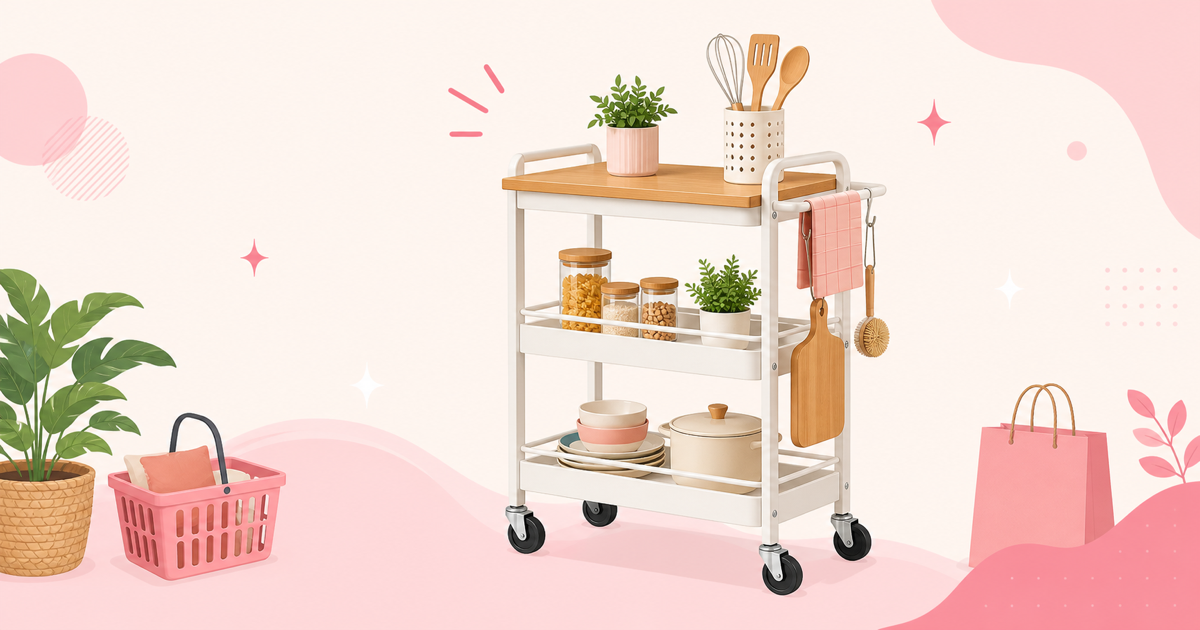

The Right Kitchen Cart Depends on Where You'll Put It and What You'll Use It For
If your kitchen is short on storage or you're struggling to find a spot for condiments and food staples, "I'll just buy a kitchen cart" is a natural first thought. But once you start comparing options, the range is huge — from ultra-slim 15cm-wide models to basket-style carts over 40cm wide — and it's hard to know which one actually fits your kitchen.
Most disappointments come down to a mismatch: buying without measuring the space, only to find it doesn't fit, or prioritizing storage capacity so heavily that the cart ends up blocking your workflow. Kitchen carts are cumbersome to return or exchange once you've picked the wrong size, so it pays to know what to check before you buy.
This article walks through the key criteria for choosing a kitchen cart, then compares six popular models by size, material, and caster quality. By the end, you'll be able to pick the one that fits your kitchen's gap and the items you actually need to store.
How to Choose a Kitchen Cart: 4 Criteria That Prevent Costly Mistakes
Choose Based on Actual Measurements of Your Space
Size is where most kitchen cart purchases go wrong. Before choosing a model, measure the width, depth, and height of the spot you have in mind — whether it's the gap between the fridge and the wall or an open space under the sink — with an actual tape measure. This matters especially for slim models around 15cm wide, where even a few centimeters of error can make the cart impossible to install. Beyond measuring, it's worth checking whether opening nearby cabinet doors or drawers will interfere with the cart. If your main goal is food prep support or ingredient storage, a basket-style cart around 40cm wide will make better use of its storage capacity.
Choose Based on Material and Weight Capacity
Steel models resist water and oil stains well and wipe clean easily, making them well-suited to kitchen use. Wood models blend more naturally into a room's interior and double nicely as a shared piece with the living room or as a worktop, but they're less water-resistant — if you'll be using one near a sink, check whether the tabletop has a waterproof finish. For weight capacity, look at the rating per shelf: if you plan to store heavy items like beverage cases or bags of rice, aim for a model rated at 10kg or more per shelf.
Choose Based on Caster Quality and Whether Stoppers Are Included
Since this is furniture you'll move daily, how smoothly the casters roll makes a real difference in usability. Checking review trends can help you judge whether a cart glides without catching on flooring or carpet, and whether it turns smoothly. It's also worth choosing a model where all or at least two of the wheels have locking stoppers, since a cart that shifts mid-cooking can be genuinely dangerous.
Choose Based on Shelf Flexibility and Expandability
If you're planning to place appliances like a rice cooker or kettle on the cart, whether the shelf height is adjustable makes a big difference in usability. Fixed-shelf models are easy to assemble but harder to match to the height of what you're storing. Models with a built-in outlet let you run a cooking appliance directly on the cart, which can effectively expand your workspace in a tight kitchen.
Spec Comparison Table
| Product | Approximate Width | Material | Casters / Stoppers |
|---|---|---|---|
| Yamazen Basket Trolley | Standard width, 3-tier baskets | Steel (deep baskets) | All-wheel casters, some with locks |
| Iris Ohyama Kitchen Wagon | Standard width, adjustable shelf height | Steel | All-wheel casters with locks |
| Yamazaki Jitsugyo tower Slim Wagon with Handle | Ultra-slim, approx. 12cm wide | Steel (powder-coated) | All-wheel casters, handle for easy pulling |
| IKEA RÅSKOG Cart | Standard width, 2-tier | Steel (powder-coated) | All-wheel casters |
| Pearl Metal Kitchen Wagon | Standard width, 3-tier | Steel (lightweight) | All-wheel casters |
| Bonkagu Wooden Kitchen Wagon | Standard width, 2-3 tier with tabletop | Natural wood (tabletop doubles as worktop) | All-wheel casters |
6 Recommended Kitchen Carts
Yamazen Basket Trolley
A classic-style cart with stacked deep steel baskets. It comes in a wide range of colors and is designed to work equally well in the kitchen, bathroom, or living room.
Pros
- Deep baskets hold bulky items like condiment bottles and root vegetables together
- Wide color selection makes it easy to match your room's style
- Simple assembly means you can start using it right after delivery
Cons
- The open basket structure means small condiment items can tip over inside
- Being all-steel, it's fairly heavy and cumbersome to move when rearranging furniture
Best for
Anyone who wants strong storage capacity and versatility, and plans to use the cart in rooms beyond the kitchen.🛒 Check the price →
Iris Ohyama Kitchen Wagon
Its standout feature is adjustable shelf height, which lets it flexibly accommodate tall bottles and small appliances. Choose the outlet-equipped model and you can even run cooking appliances directly on the cart.
Pros
- Adjustable shelf heights adapt easily as your storage needs change
- Tool-free assembly design
- Outlet-equipped models double as a workspace
Cons
- Because the shelves are adjustable, weight capacity tends to run somewhat lower than fixed-shelf models
- Outlet-equipped models tend to sit at a higher price point
Best for
Anyone who wants a spot for appliances like a rice cooker or kettle and values functionality above all.🛒 Check the price →
Yamazaki Jitsugyo tower Slim Wagon with Handle
At roughly 12cm wide, this ultra-slim design turns even the narrowest gap beside the fridge into usable storage. The built-in handle makes it easy to pull out, and its monotone design keeps things simple.
Pros
- Slim enough to fit into extremely tight spaces
- The handle makes it easy to pull out smoothly even from a narrow gap
- Simple design that suits any kitchen style
Cons
- Its narrow width means less storage per shelf than other types
- Not well suited to larger cookware or bulk food storage
Best for
Anyone who wants to make the most of dead space and prioritizes fitting into tight gaps above all else.🛒 Check the price →
IKEA RÅSKOG Cart
A well-known staple of Scandinavian design. Its powder-coated steel construction resists rust, and it comes in muted colorways that prioritize interior appeal.
Pros
- Powder coating resists rust and keeps its appearance from deteriorating over time
- Muted color options blend well into interior decor
- Sturdy build that holds up well over long-term use
Cons
- With only 2 tiers, it offers fewer storage levels than other types
- Availability can be limited in physical stores, making online purchase the main route in some areas
Best for
Anyone who values design over raw storage capacity and wants the cart to double as part of their interior decor.🛒 Check the price →
Pearl Metal Kitchen Wagon
A 3-tier cart from Pearl Metal, a brand well known for cookware. Its lightweight design prioritizes easy assembly.
Pros
- Lightweight, making it easy to carry and move when rearranging
- Simple assembly that's approachable even for first-timers
- 3-tier layout covers basic storage needs
Cons
- The lightweight build means it's somewhat less stable when loaded with heavy items
- Fewer design options compared to other brands
Best for
Anyone buying their first kitchen cart who wants something easy to handle and straightforward.🛒 Check the price →
Bonkagu Wooden Kitchen Wagon
A wooden cart with a tabletop that doubles as a worktop for plating dishes or prepping ingredients. Its natural wood grain pairs well with café-style interiors.
Pros
- The tabletop serves as extra workspace, useful when your countertop is too small
- Wood-grain design pairs well with natural or café-style interiors
- Works just as well outside the kitchen, in living rooms or dining areas
Cons
- Being made of wood, it's less water- and oil-resistant than steel models
- If the tabletop lacks a waterproof finish, it's best to avoid placing wet dishes on it directly
Best for
Anyone who wants an auxiliary prep surface and values interior design as well.
How to Choose by Purpose
- Prioritizing dead-space storage in a tight kitchen: The Yamazaki Jitsugyo tower, at about 12cm wide, is the top pick — it turns the dead space beside the fridge into usable storage.
- Balancing storage capacity and value: The Yamazen Basket Trolley is the classic choice, with deep baskets that hold ingredients and condiments together.
- Wanting a spot for appliances too: The Iris Ohyama, with adjustable shelf heights and outlet-equipped models available, fits the bill.
- Prioritizing design and interior appeal: The IKEA RÅSKOG with its muted colorways, or the wood-grain Bonkagu model, are strong candidates.
- Wanting a simple first cart: The lightweight, easy-to-assemble Pearl Metal is approachable as an entry-level model.
- Wanting extra prep space too: The Bonkagu wooden model with its tabletop doubles as a workspace.
FAQ
Q. How much of a gap do I need to fit a kitchen cart?
It varies by product, but some slim models can fit into gaps as narrow as about 15cm wide. Keep in mind that pulling the cart out also requires clearance equal to its depth, so check the clearance in front of it, not just the width of the gap itself.
Q. Is it dangerous if the casters don't have locks?
Without any locks at all, vibration from cooking or an uneven floor can cause the cart to shift. This matters especially if you'll temporarily set down a hot pot or a knife on it — choosing a model where at least some wheels have stoppers adds an extra margin of safety.
Q. Which is better for the kitchen, wood or steel?
If your use case involves a lot of water splashes or oil stains, steel tends to be easier to manage and wipe clean. Wood has an edge in looks and works well as a prep surface, but if you'll use it near a sink, check whether the tabletop has a waterproof finish first.
Q. What weight capacity per shelf should I look for?
If you plan to store heavy items like cases of bottled drinks or bags of rice, look for a model rated at 10kg or more per shelf. If you're mainly storing light condiments and dishware, a lower weight capacity works fine.
Q. Can a kitchen cart be used in rooms other than the kitchen?
Yes — many steel basket-style carts are designed to double as storage in the bathroom, living room, or a child's room. It's worth keeping future use cases in mind before buying, since that flexibility helps you get more long-term value out of it.
Conclusion
When choosing a kitchen cart, the key to avoiding a mismatch is checking four things: actual measurements of your space, material and weight capacity, caster quality, and shelf flexibility.
- For dead-space storage above all: View on Amazon →
- For a balance of storage and value: View on Amazon →
- For a spot to place appliances too: View on Amazon →
- For design-first picks: View on Amazon → or View on Amazon →
- For a simple first cart: View on Amazon →
Match your choice to the gap in your kitchen and the items you need to store, and you'll find the cart that fits your space best.


![[2026 Latest] Top 5 Yogurt Maker Rankings|Complete Comparison Guide](/images/eyecatch/articles/yogurt-maker-ranking-top5.png)
![[2026 Latest] Top 5 Bento Box Rankings|A Thorough Comparison](/images/eyecatch/articles/bento-box-recommended-ranking-top5.png)
![[2026 Latest] Cutting Board Comparison: A Thorough Test of Wood, Plastic, and Antibacterial Materials](/images/eyecatch/articles/cutting-board-comparison-2026.png)
![[2026 Latest] Best Electric Kettles Compared — Which One Should You Buy?](/images/eyecatch/articles/electric-kettle-ranking-comparison-2026.png)