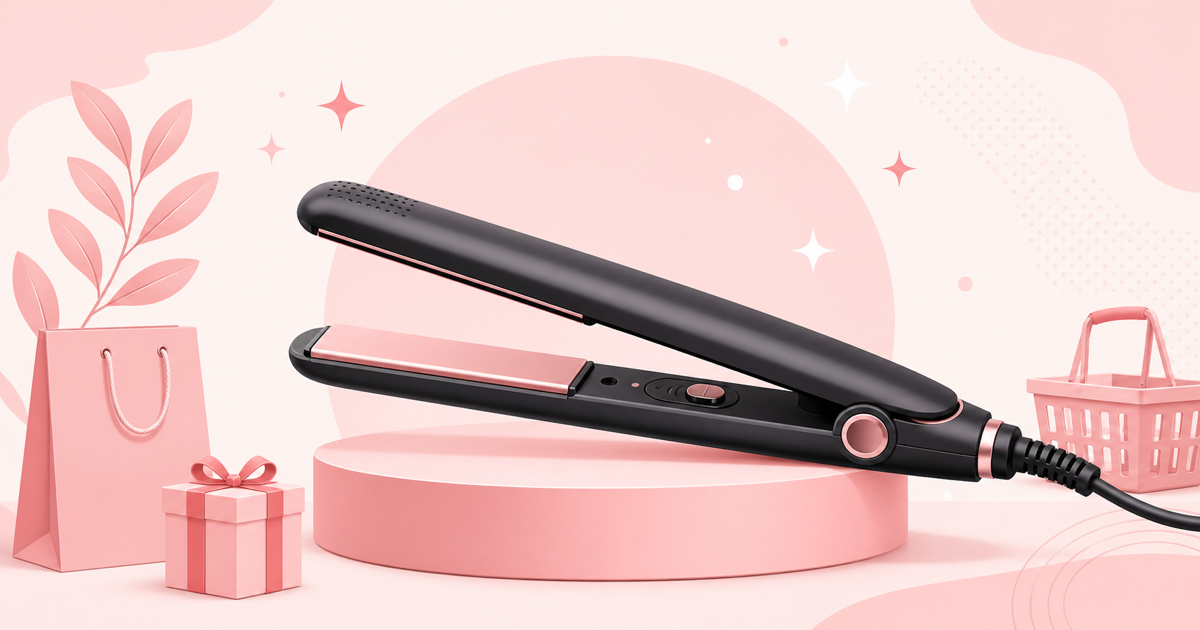

Are You Struggling to Choose the Right Hair Straightener Every Morning?
"Ceramic," "titanium," "nanoe"—the shelves at electronics stores are packed with hair straighteners that all sound the same, making it hard to tell what actually sets them apart. Plenty of people have picked a cheap model only to end up with dry, frizzy hair—or splurged on a high-end model that turned out to be the wrong fit for their hair type.
A hair straightener applies high heat directly to your hair, right next to your skin, every single day. Three specs—plate material, temperature range, and plate width—determine most of the final result and how much damage your hair takes. In other words, once you understand these three factors, choosing the right iron for you becomes straightforward.
This article breaks down the key criteria for choosing a hair straightener, then compares seven recommended models—both straightening and curling irons—spec by spec. Rather than choosing based on price or brand image alone, use this guide to find the one iron that truly fits your hair type and how often you use it.
How to Choose a Hair Straightener|4 Criteria for Avoiding a Bad Purchase
① Plate Material Affects Both Finish and Hair Damage
The plate material directly affects how heat transfers to your hair and how much friction it creates.
- Ceramic: Heat spreads evenly and tends to cause relatively little damage. The smooth surface also makes it easy to handle, ideal for first-time users
- Titanium: High thermal conductivity means it heats up fast. It handles coarse or very curly/wavy hair with more power, though temperature control can be trickier
- Teflon/fluorine coating: Exceptionally smooth surface that glides through hair without tugging. A good choice if you're worried about split ends from friction
Even among products labeled "ceramic plate," there's a difference between an aluminum core with a ceramic coating and a plate made of high-purity ceramic throughout—the latter heats more evenly. Checking the "plate structure" listed in the spec sheet can help you choose more precisely.
② Temperature Range Determines How Well It Suits Your Hair Type
The ideal temperature depends on how thick or damaged your hair is.
- Fine hair or hair damaged by coloring/bleaching: A lower range (around 120–160°C) is often enough to style effectively
- Standard hair: Around 160–190°C is easy to work with
- Thick or very curly/wavy hair: Curls or straight styles may not hold unless the temperature reaches 180°C or higher
Fixed-temperature models (with only one setting) are simple to use, but they can't adapt if your hair type changes. If multiple family members share the iron, or if you want to adjust for the season or your hair's condition, a model with finer controls—five or more settings—will serve you longer.
③ Choose Plate Width/Barrel Diameter Based on Hair Length and Purpose
Plate width on straighteners and barrel diameter on curling irons affect both the range of styling and how long it takes.
- 24mm or less: Good for detailed styling of bangs and hair ends, but takes longer for full-head styling
- 28–32mm: A standard size that's easy to use for full-head styling on medium to long hair
- Over 32mm: The larger surface saves time on long hair, though the iron becomes somewhat heavier to handle
For curling irons, keep in mind that a larger barrel diameter creates looser waves, while a smaller one creates tighter curls.
④ Heat-Up Time, Weight, and Extra Features Affect Everyday Usability
Beyond the numeric specs, everyday usability is also worth factoring into your decision.
- Heat-up time: How many minutes you can spare on a busy morning matters more than you'd think
- Weight: When curling or straightening long hair, even a difference of a few dozen grams affects arm fatigue
- Extra features: Moisture-focused features like negative ions, nanoe, or steam are useful if dryness or static-related frizz is a concern
Hair Straightener Spec Comparison Table
| Product | Type | Temperature Range | Plate Width/Barrel Diameter |
|---|---|---|---|
| Panasonic Nanocare Straightener EH-HS0E | Straightener | 160–200°C (5 settings) | 24mm |
| SALONIA Ceramic Straightener 24mm | Straightener | Approx. 230°C (fixed) | 24mm |
| Creaite Ion Pro Straightener 32mm | Straightener | 140–220°C | 32mm |
| ReFa Beautech Flat Iron | Straightener/Curler combo | 60–230°C | 28mm |
| VIDAL SASSOON Curling Iron 32mm VSI-3225 | Curler | Adjustable settings | 32mm |
| Nobby by TESCOM Professional Straightener NIS5001 | Straightener | Covers high-temperature range | Professional-grade spec |
| YA-MAN Photo Steam Straightener EP-14BB | Straightener (steam) | Adjustable settings | Built-in steam mechanism |
7 Recommended Hair Straighteners & Curling Irons
Panasonic Nanocare Straightener EH-HS0E
A high-end model from Panasonic. Its nanoe technology is designed to help maintain your hair's internal moisture balance even during high-heat styling, and the 5-level temperature control (160–200°C) lets you adjust settings to match your hair type.
Pros
- The nanoe mechanism helps suppress dryness-related frizz and flyaways
- 5-level temperature control lets you adjust for your hair type
- Built with everyday use in mind, with attention to durability
Cons
- As a premium model, it's priced higher than entry-level options
- The 24mm plate width takes a bit longer to cover larger sections of hair at once
Best for: Anyone who uses a straightener daily and wants to prioritize hair-damage prevention.🛒 Check the price →
SALONIA Ceramic Straightener 24mm
An entry-level-priced model that still uses ceramic plates, delivering a solid straightening effect at a fixed high temperature of around 230°C. It's also relatively lightweight and easy to handle.
Pros
- Delivers a ceramic-plate finish at an entry-level price point
- Lightweight and easy to handle, great as a first iron
- The fixed high temperature means it rarely lacks power, even for very curly hair
Cons
- Since the temperature is fixed, it may be too hot for fine or damaged hair
- Lacks the moisture-focused extra features found on higher-end models
Best for: First-time buyers or anyone looking to keep costs down.🛒 Check the price →
Creaite Ion Pro Straightener 32mm
A standard model from Creaite, a brand trusted by professional hairstylists. With a wide 140–220°C temperature range, a proprietary ion mechanism, and a 32mm plate width, it's designed to handle a variety of hair types and volumes.
Pros
- The wide 140–220°C range allows fine-tuned settings for your hair type
- The 32mm plate width saves time styling long hair overall
- Backed by the credibility of a professional-grade brand
Cons
- The wider plate makes it harder to fine-tune small sections like bangs
- Somewhat heavier than other models
Best for: Anyone with medium to long hair who wants to fine-tune temperature settings by hair type.🛒 Check the price →
ReFa Beautech Flat Iron
With an exceptionally wide 60–230°C temperature range, this combo model handles not just straightening but curls and waves too. Its 28mm plate width strikes a good balance for both straightening and curling use.
Pros
- The wide 60–230°C range also supports low-temperature styling
- Handles both straightening and curling in a single iron
- Highly design-conscious, making it a popular gift choice
Cons
- Its versatility comes at a premium price point
- As a combo iron, plate contact may be slightly less tight than a dedicated straightener
Best for: Anyone who wants to switch between straightening and curling with one iron.🛒 Check the price →
VIDAL SASSOON Curling Iron 32mm VSI-3225
A curling iron with a 32mm barrel diameter, capable of a wide range of styles from loose waves to tighter curls. It's designed to be easy to handle even for curling-iron beginners.
Pros
- The 32mm barrel makes it easy to create loose waves
- Beginner-friendly as an entry-level curling iron
- A well-known brand, making it easy to find information about it
Cons
- The fixed barrel diameter isn't ideal if you want to switch between multiple curl widths
- Can't be used as a straightener
Best for: Anyone trying a curling iron for the first time.🛒 Check the price →
Nobby by TESCOM Professional Straightener NIS5001
A professional model from Nobby, a brand favored by hairstylists. It's built to fully handle high temperatures, making it easier to set a straight style quickly even on very curly or thick hair.
Pros
- Near-professional-grade spec that rarely lacks power
- Handles very curly hair and thick hair volumes well
- Backed by the credibility of a professional-grade brand
Cons
- Since it handles high temperatures, extra care with temperature settings is needed for fine or damaged hair
- Priced higher than typical entry-level models
Best for: Anyone with very curly hair who found previous models lacking in styling power.🛒 Check the price →
YA-MAN Photo Steam Straightener EP-14BB
A straightener with a built-in steam mechanism that styles using steam power in addition to heat. It's designed with features aimed at those concerned about dryness-related frizz and static.
Pros
- The steam mechanism helps counter dryness and static
- The combination of heat and steam is designed to ease the strain on hair
- Backed by the technical expertise of a beauty-device brand
Cons
- The steam mechanism means more maintenance than a standard model
- Requires prep steps like adding water, which may not suit anyone prioritizing speed
Best for: Anyone concerned about frizz caused by dryness or static.
Choosing by Purpose and Use Case
- Looking for your first iron: The SALONIA Ceramic Straightener 24mm offers a great balance of price and ease of use
- Prioritizing hair-damage prevention: Models with moisture-focused features, like the Panasonic Nanocare Straightener or YA-MAN Photo Steam Straightener, are strong options
- Very curly hair or thick hair volume: Models that reach higher temperatures, like the Creaite Ion Pro or Nobby by TESCOM Professional, are well-suited
- Want to switch between straightening and curling with one iron: The ReFa Beautech Flat Iron is a good option
- Want to try curling styles: The VIDAL SASSOON Curling Iron 32mm is beginner-friendly
FAQ
Q. How long does a hair straightener typically last?
It varies depending on how often you use it and how well you maintain it, but if the plate coating starts to peel or the iron no longer reaches its set temperature, that's a sign it's time to replace it. Cord damage or scratched plates should also be addressed promptly for safety reasons.
Q. Should I buy a straightener or a curling iron first?
As a general rule, choose a straightener if your everyday style is straight-based, or a curling iron if you frequently create curled styles. If you want to do both, a combo model like the ReFa Beautech Flat Iron is also worth considering.
Q. Will using a straightener daily damage my hair?
It depends on the temperature setting and how you use it. You can minimize damage by using a temperature suited to your hair type, avoiding prolonged heat on the same section, and protecting your hair with a leave-in treatment before styling. If your hair is fine enough to style at low temperatures, an adjustable-temperature model is a better fit than a fixed high-temperature one.
Q. Does a wider plate mean faster styling?
Generally, a wider plate covers more hair at once, which saves time. That said, for detailed styling of bangs or hair ends, a narrower model can be easier to work with. It's best to choose based on your hair length and style.
Q. Ceramic or titanium—which is better overall?
If minimizing damage is your priority, go with ceramic; if you prioritize power and fast heat-up, go with titanium. Ceramic is often more than enough for hair that isn't very curly, so if you're unsure, starting with a ceramic-plate model is a safe bet.
Conclusion
The key criteria for choosing a hair straightener are plate material, temperature range, plate width (or barrel diameter), and heat-up time/weight.
- For your first iron or if cost matters most: SALONIA Ceramic Straightener
- To minimize hair damage: Panasonic Nanocare or YA-MAN Photo Steam
- For very curly hair or thick hair volume: Creaite Ion Pro or Nobby by TESCOM
- To combine straightening and curling: ReFa Beautech
- For curling beginners: VIDAL SASSOON
By comparing specs against your own hair type and how you plan to use the iron, you'll be able to find the model that's truly right for you—something price or brand image alone can't tell you.


![Nail Care Tools Comparison Ranking [2026 Latest]: A Complete Buying Guide](/images/eyecatch/articles/nail-care-products-ranking-2026.png)

![[2026 Latest] Shampoo Comparison: Best-Selling Drugstore and Salon Picks Ranked](/images/eyecatch/articles/shampoo-comparison-2026-best-ranking.png)
![[2026 Latest] Electric Toothbrush Comparison Ranking|The Ultimate Guide](/images/eyecatch/articles/electric-toothbrush-ranking-comparison.png)