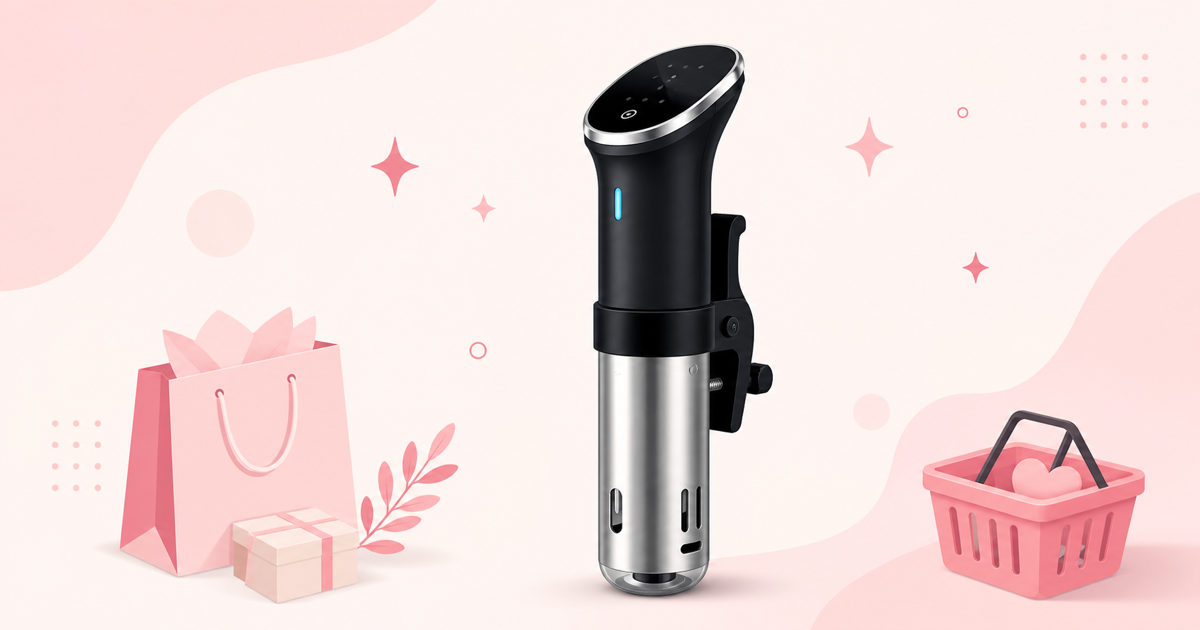
The Appliance That Fixes Dry, Rubbery Chicken Breast for Good
When you cook chicken breast or roast beef with conventional heat, it's easy to overshoot the temperature range where protein turns tough, leaving the meat dry and stripped of moisture. A sous vide cooker keeps water at a constant temperature — controlled in increments of just 0.5 to 1°C — so food cooks slowly through to the center while never crossing into that "toughening" zone.
Just place water and your food (in a vacuum-sealed or sealed bag) in a pot, set the device, and walk away. There's no need to monitor the heat, which is why sous vide cookers are popular for meal prepping in dual-income households and for making chicken breast salads during strength training routines.
That said, choosing the right model isn't obvious without comparing specs. This article breaks down the key criteria for picking a sous vide cooker without regrets, along with a detailed comparison of five leading models.
How to Choose a Sous Vide Cooker: 4 Criteria for a Confident Pick
1. Power Consumption (Wattage) — Determines Preheat Speed and Stability
A sous vide cooker needs time to bring the entire volume of water up to the target temperature during "preheating." Lower-wattage models not only take longer to preheat, they're also more prone to temperature unevenness in larger pots.
As a general guideline:
- Around 800W: Suited to standard pots and smaller water volumes
- 1000W or more: Preheats faster and stays stable even in larger stockpots
If you plan to cook for the whole family at once, or you switch pots frequently, choosing 1000W or higher will cut down on waiting-time frustration.
2. Supported Water Volume and Attachment Type — Compatibility With Your Pot
Sous vide cookers come with two key specs: the maximum water volume they can handle, and how they attach to the pot.
Supported Water Volume
- 5–10L: Suited to solo living and small-batch cooking
- Around 15L: Suited to family-sized batches or stockpot use
Attachment Type
- Clip-on: Simply clamps to the rim of the pot. Works with a wide range of pot shapes and is easy to handle
- Screw-mount: Secured with a screw for greater stability, though it can be limited by how thick the pot rim can be
Always check your usual pot's depth and rim shape against the device's supported water volume before choosing.
3. Waterproof Rating (IPX Standard) — Durability as a Water-Adjacent Appliance
Since part of a sous vide cooker's body is submerged in water during use, its waterproof rating is directly tied to its lifespan. The rating is expressed as a number following "IPX," with a higher number indicating stronger waterproofing.
- IPX7: A level unlikely to fail even with brief submersion — effectively the standard baseline for sous vide cookers
- Below IPX7 or unspecified: Requires more careful management of the water level line
Always check the product's spec sheet to confirm whether a waterproof rating is listed.
4. App Integration and Recipe Support — Especially Valuable for Beginners
The right temperature-and-time combination varies by ingredient, and figuring out "what temperature for how long" can be confusing when you're just starting out. Models that connect to a smartphone app let you check progress remotely, and often come with recommended temperatures and times built into the app for each recipe, reducing the risk of setting errors.
Even without app integration, a model backed by a solid official website or recipe collection from the manufacturer can offer the same peace of mind. It's worth checking how much recipe content a manufacturer provides before you buy.
Spec Comparison Table
| Product | Power Consumption | Supported Water Volume | Waterproof Rating |
|---|---|---|---|
| BONIQ 2.0 | 1000W | Up to approx. 15L | IPX7 |
| Iris Ohyama LTC-02 | 1000W | Up to approx. 10L | IPX7 |
| Anova Precision Cooker Nano | 750W | Up to approx. 10L | IPX7 |
| Kai House aio | Approx. 800W range | Fixed to dedicated pot size | IPX7 |
| Hagoogi Sous Vide Cooker | 1100W | Up to approx. 15L | IPX7 |
*Specs above are approximate, based on manufacturer listings. Always check the product page for the latest information before purchasing.
Top 5 Sous Vide Cooker Picks

1. BONIQ 2.0 | The Go-To Domestic Standard When You Can't Decide
💰 ¥31,500
This model comes from the domestic brand that has led Japan's sous vide cooking boom. Its powerful 1000W output preheats quickly, and the minimalist design means it won't feel out of place left out on the counter. The official website offers a well-organized library of temperature and time recipes, making it easy to find information even for first-time users.
Pros
- 1000W power for shorter preheat times
- Extensive official recipes make temperature/time settings easy to figure out
- Simple design that blends into any kitchen
Cons
- Sits in a higher price bracket, which can feel like a lot for an entry-level purchase
- The clip-on attachment may need position adjustment depending on your pot's shape
Best for
First-time sous vide buyers who value brand track record and easy-to-find recipes. 🛒 Check the price →
2. Iris Ohyama LTC-02 | The Best Value Entry-Level Pick
This sous vide cooker comes from Iris Ohyama, a brand with a strong track record in household appliances. Despite its entry-level pricing, it delivers a full 1000W of power, and its controls are kept simple with just a dial and touch panel. It's built for anyone who wants to try sous vide cooking for the first time.
Pros
- Full 1000W power at an entry-level price point
- Simple controls that are easy to use even if you're not mechanically inclined
- Peace of mind from a domestic manufacturer's support
Cons
- Fewer extra features, such as app integration, compared to other models
- Supported water volume leans toward small-to-medium batches rather than family-sized cooking
Best for
Anyone trying sous vide cooking for the first time who wants to keep the initial cost low.🛒 Check the price →

3. Anova Precision Cooker Nano | Unmatched App Integration
💰 ¥9,719
This compact model comes from Anova, a pioneer in sous vide cooking. It connects to a smartphone app via Bluetooth, letting you set the temperature and check cooking progress right from your phone. Its standout strength — not matched by other brands — is access to recipes submitted by users worldwide, which opens up more possibilities as you get more comfortable with the device.
Pros
- Set temperature/time and check progress from the app
- Access to user-submitted recipes from around the world
- Compact body that's easy to store
Cons
- Some menus and settings in the app appear in English
- At 750W, preheating can take a bit longer with larger pots
Best for
Anyone who wants to actively use smartphone-based temperature control and recipe search. 🛒 Check the price →
4. Kai House aio | An All-in-One With a Dedicated Pot Included
This all-in-one model comes from Kaijirushi, a brand well known for cutlery, and is bundled with a dedicated pot. There's no need to source a separate pot of the right size or shape — you can start cooking as soon as it arrives. Its body and pot can be stored together as a set, making it easy to keep your storage space tidy.
Pros
- Bundled dedicated pot removes the hassle of choosing one yourself
- Ready to use right out of the box
- Body and pot can be stored together
Cons
- Supported water volume is fixed to the dedicated pot's size, making it unsuited to large-batch cooking
- Not well suited to use with large third-party stockpots
Best for
Anyone who wants to skip the hassle of pot selection and setup and start sous vide cooking right away.🛒 Check the price →
5. Hagoogi Sous Vide Cooker | 1100W Power and Waterproofing Made Easy
This model delivers a powerful 1100W output, reaching the target temperature relatively quickly. Its IPX7 waterproof rating supports full washing, and the touch panel offers clear visibility. It's built for anyone who wants to balance power and waterproofing at an entry-to-mid price range.
Pros
- 1100W keeps preheat times short
- IPX7 waterproofing makes it easy to keep clean and hygienic
- Touch panel controls that are easy to read
Cons
- Less brand information available compared to major manufacturers
- Extended features like dedicated app integration are limited
Best for
Anyone who wants to keep costs down while still getting solid power and waterproofing.
How to Choose by Use Case
- Want the cheapest way to try sous vide cooking: Iris Ohyama LTC-02. It delivers full 1000W power at an entry-level price, making it a solid choice for your first unit.
- Value easy-to-find recipes and information: BONIQ 2.0. As a domestic brand with abundant official recipes, it minimizes guesswork on temperature and time settings.
- Want to actively use smartphone-based temperature control: Anova Precision Cooker Nano. Offers app-based operation and access to recipes from around the world.
- Want to skip the hassle of pot selection: Kai House aio. Comes bundled with a dedicated pot, so you can start using it confidently from day one.
- Value a balance of power and waterproofing: Hagoogi Sous Vide Cooker. Combines 1100W output with IPX7 waterproofing.
FAQ
Q. Is there a risk of undercooked food with a sous vide cooker?
There's no need to worry as long as you heat food at the correct temperature and time. Japan's Ministry of Health, Labour and Welfare guidelines suggest a core meat temperature of 63°C for at least 30 minutes (or an equivalent heating condition) as a benchmark. Following the temperature and time specified in a recipe is the foundation of safe cooking.
Q. Can I use a regular zip-top storage bag as a sealed bag?
Use a bag that's explicitly labeled as heat-resistant and suitable for hot water immersion. Standard storage bags may not withstand the temperatures used in sous vide cooking, risking deformation or leaks. Choose a dedicated vacuum-seal bag or one labeled as safe for hot water use.
Q. What's the difference between a sous vide cooker and a slow cooker?
The key difference is temperature control precision. A sous vide cooker can hold water temperature steady in increments of 0.5–1°C, while a slow cooker is more prone to uneven heating and only offers rough temperature settings. If you want to finish food precisely within a target temperature range, a sous vide cooker is the better choice.
Q. Are there any tips for cleaning and storage?
After use, rinse the parts of the device that come into contact with water and let them dry thoroughly before storing. Even with an IPX7-rated model, it's safer to avoid leaving it submerged for extended periods. It's also a good idea to coil the cord loosely for storage to prevent it from developing a permanent bend, which helps it last longer.
Q. Do I need to buy a separate pot to use a sous vide cooker?
Aside from bundled models like the Kai House aio, you'll generally use a pot you already own. Before purchasing, it's worth checking that the model's supported water volume and attachment type (clip-on or screw-mount) are compatible with your pot at home.
Summary
Here are the four key points to check when choosing a sous vide cooker:
By use case, the Iris Ohyama LTC-02 is the pick if price matters most, the BONIQ 2.0 if you value easy-to-find information, the Anova Precision Cooker Nano if you're an app-loving type, the Kai House aio if you want to skip the hassle, and the Hagoogi Sous Vide Cooker if you want a balance of power and waterproofing. Choose the model that fits how often you cook and the pot you already have, and you should see a big drop in everyday cooking mishaps.


![[2026 Latest] Top 5 Yogurt Maker Rankings|Complete Comparison Guide](/images/eyecatch/articles/yogurt-maker-ranking-top5.png)
![[2026 Latest] Top 5 Bento Box Rankings|A Thorough Comparison](/images/eyecatch/articles/bento-box-recommended-ranking-top5.png)
![[2026 Latest] Cutting Board Comparison: A Thorough Test of Wood, Plastic, and Antibacterial Materials](/images/eyecatch/articles/cutting-board-comparison-2026.png)
![[2026 Latest] Best Electric Kettles Compared — Which One Should You Buy?](/images/eyecatch/articles/electric-kettle-ranking-comparison-2026.png)