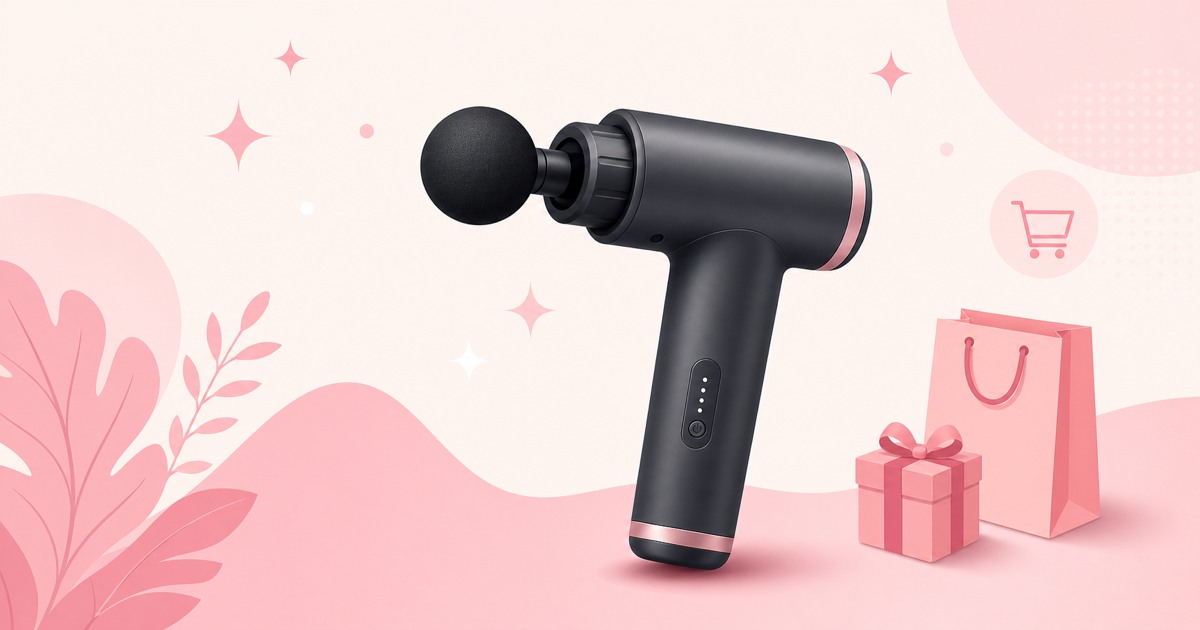
What Is a Massage Gun? The Basics Before You Buy
Stiff shoulders and necks from desk work, sore thighs and calves after training — the fatigue that kneading alone can't fix often comes from adhesions in the fascia deep within your muscles. A massage gun is an electric device that delivers high-speed vibration deep into the muscle to release these adhesions at home, a technique known as "myofascial release."
That said, massage guns vary enormously in performance from one product to the next. Choose a model with low vibration frequency or amplitude (stroke depth), and you may end up feeling like it's "just skimming the surface" with no real effect. On the other hand, using a power-focused model for light shoulder tension can leave you with something too heavy and unwieldy — a mismatch in the opposite direction.
Rather than relying on vague indicators like price or review count, this article breaks down how to choose based on five concrete spec dimensions — vibration frequency, amplitude, weight, battery life, and noise level — and recommends models by use case. By the end, you'll be able to judge which model fits your needs just by reading the spec sheet.
How to Choose a Massage Gun: 5 Criteria for Avoiding a Bad Pick
① Vibration Frequency (RPM/PPS) Determines the Intensity
Vibration frequency is shown as strikes per minute (RPM) or strikes per second (PPS). The lower the number, the softer the stimulation; the higher, the stronger.
- Around 1,200–2,000 rpm: Suited to areas with thin skin and nerves close to the surface, like the shoulders and neck
- Around 2,000–3,200 rpm: Suited to muscle-dense areas like the thighs and calves, or deep-tissue recovery after exercise
Models with adjustable intensity levels can cover both needs in a single device. Be sure to check the adjustment range (e.g., 3 levels vs. 5+ levels), since it directly determines how versatile the device is across body parts.
② Stroke (Amplitude) Determines How Deep It Reaches
Stroke refers to the distance the head moves back and forth. If vibration frequency is "speed," stroke is the spec that determines "depth."
- Around 8–10mm: Suited to relaxing muscles near the surface
- Around 12–16mm: Reaches deeper muscle layers, suited to sports recovery
Even a product marketed as "powerful" can feel "fast but not reaching anywhere" if it has high frequency but shallow stroke. Conversely, a beginner jumping straight into a model with an overly deep stroke may find the sensation too intense to sustain — so it's important to choose based on your actual purpose.
③ Weight and Grip Shape Determine Whether You'll Keep Using It
No matter how high-performance a device is, it's pointless if it's too heavy to bother picking up.
- Around 500g or less: Comfortable to hold one-handed for extended periods, and easy to carry when traveling or at work
- 700g or more: Tends to have a larger, higher-output motor, but also puts more strain on your arm
If you want to use the device solo on hard-to-reach areas like your back, checking whether the grip angle is adjustable — not just the weight — will help you avoid a bad fit.
④ Battery Life Shapes How You'll Use It
Continuous use time on a single full charge varies significantly between models. For a few minutes of self-care a day, even short battery life is plenty. But if you plan to share the device with family, or have multiple people use it back-to-back after training, prioritize long battery life and fast charging. USB-C support is also a practical point worth checking, since it affects how easily you can charge on the go.
⑤ Noise Level (dB) Determines Where You Can Use It
Operating noise varies quite a bit between massage gun models. As a rough guideline, around 45dB or below is generally unnoticeable even while on a call or watching a video, while models above 60dB can be hard to use at night or in apartments with thin walls. If you plan to use it in an office or late at night, be sure to check whether the product advertises quiet-operation design.
Spec Comparison Table
| Product | Frequency (approx.) | Stroke (approx.) | Weight (approx.) |
|---|---|---|---|
| Theragun Prime | High, 5 levels | 16mm | ~800g |
| Hyperice Hypervolt 2 | Medium-High, 3 levels | 10mm | ~700g |
| RENPHO Massage Gun | Medium, multiple levels | ~10mm | ~600g |
| Anker PowerCore Massage Gun | Medium, multiple levels | 8–10mm | ~600g |
| Body Trainer Mini Massage Gun | Medium, several levels | 6–8mm | ~300g (ultra-light) |
| TOLOCO Massage Gun Pro | Medium-High, 30 levels | 10–12mm | ~600g |
| Achedaway Pro Massage Gun | High, high-output design | 12–16mm | ~700g |
*Figures are approximate, based on each product's published specifications. Please check the product page for the latest exact figures before purchasing.
7 Recommended Massage Guns

Theragun Prime|The Go-To Model for Serious Recovery
💰 ¥59,400
The flagship model from Therabody, the brand leading the industry. It features a deep 16mm stroke and 5-speed adjustment, and pairs with a dedicated app that offers guidance for each body part you're treating.
Pros
- 16mm stroke reaches deep into muscle tissue
- App integration guides you on target areas and intensity
- Backed by strong brand reputation and durability
Cons
- Slightly heavy, which can tire out one-handed use over time
- Priced at the premium end of the lineup
Best for: Serious athletes who want thorough, deep-tissue recovery 🛒 Check the price →
Hyperice Hypervolt 2|A Balanced Pick for Quiet Operation and Ease of Use
💰 ¥3,535
Known for its quiet-operation design, this model keeps noise down while still delivering solid power. Its grip is easy to hold, with a design that prioritizes everyday usability.
Pros
- Relatively quiet operation, suited to nighttime or home use
- Easy-to-hold grip shape, approachable even for beginners
- Leans lightweight and easy to carry
Cons
- Stroke is around 10mm, so deep-tissue reach falls a bit short of premium models
- May feel underpowered for serious users seeking high output
Best for: Anyone who wants to use it daily at home or in the office without worrying about noise 🛒 Check the price →
RENPHO Massage Gun|An Easy-to-Choose Entry-Level First Pick
A great fit for anyone who wants to "try a massage gun first." It comes with sufficient intensity levels and attachments while keeping an easy-to-handle size.
Pros
- Simple controls that are easy to use even for first-timers
- Covers the essential features at an accessible price point
- Lightweight, easy for women or older family members to handle
Cons
- Both frequency and stroke fall short of premium models in raw power
- Battery life is designed for short-duration care sessions
Best for: First-time buyers who want to try out a massage gun and see the effect🛒 Check the price →
Anker PowerCore Massage Gun|For Those Who Prioritize Battery Performance
Built on Anker's charging and battery expertise from its mobile battery products. It supports USB-C fast charging, making it especially convenient to charge while traveling or out and about.
Pros
- USB-C support means flexible charging options
- Stable battery life that doesn't require frequent recharging
- Compact design built with portability in mind
Cons
- Stroke is moderate, so deep-tissue reach is modest
- Fewer attachment types than premium models
Best for: Frequent travelers who value easy, flexible charging🛒 Check the price →
Body Trainer Mini Massage Gun|For Those Who Prioritize Portability Above All
Its standout feature is an ultra-light, palm-sized design compact enough to slip into a bag. It's well suited to keeping in a desk drawer for a quick session during a short break.
Pros
- Remarkably light at around 300g, easy to carry anywhere
- Compact size that's easy to keep on your desk or in a travel bag
- Simple to operate — anyone can pick it up right away
Cons
- Shallow stroke that struggles to reach deep muscle tissue
- Not powerful enough for serious post-workout recovery
Best for: Anyone who wants to casually loosen up their shoulders and neck at work or on the go🛒 Check the price →
TOLOCO Massage Gun Pro|Fine Intensity Control and a Wide Range of Attachments
This model stands out for its 30-level fine intensity adjustment and a rich set of attachments suited to different body parts. It's well suited to anyone who wants to treat different areas of the body with tailored settings.
Pros
- 30-level fine intensity adjustment lets you fine-tune for each body part
- Wide range of attachments makes it easy to cover the whole body
- Good balance between price and functionality
Cons
- With so many levels, it takes some initial trial and error to find your ideal setting
- Power is moderate compared to top-tier professional models
Best for: Anyone who wants to fine-tune care for different parts of the body individually🛒 Check the price →
Achedaway Pro Massage Gun|For Recovery After Intense Training
A high-output model that combines a deep stroke of around 16mm with a high vibration frequency. It's built specifically for the recovery needs of people doing intense exercise, like strength training or marathon running.
Pros
- Deep stroke and high output reach well into muscle tissue
- Powerful enough to handle intense post-workout recovery
- Well regarded among serious athletes and trainees
Cons
- The strong power can feel too intense for beginners
- Overkill for everyday relaxation use
Best for: Anyone doing intense training like strength training or marathon running
How to Choose by Use Case
- First-time buyer, want to try it out: An entry-level model like View on Amazon → is a great way to check out the basic features and usability
- Want to use it casually at work or on the go: A portability-focused model like View on Amazon → is a good fit
- Want to use it in a quiet setting (nighttime, office): Prioritize a quiet-operation model like View on Amazon →
- Want easy, flexible charging: A USB-C fast-charging model like View on Amazon → is convenient
- Want to treat the whole body with fine-tuned settings: A multi-level, multi-attachment model like View on Amazon → is a good fit
- Want serious post-workout recovery care: Choose a high-output, deep-stroke model like View on Amazon → or View on Amazon →
FAQ
Q. Is it okay to use a massage gun every day?
Most products are designed for daily use if you keep sessions to about 2–3 minutes per area. That said, avoid using it on areas with pain or inflammation, directly over bone, or on joints, and stop using it if discomfort persists.
Q. Which matters more, vibration frequency or stroke?
If you want stronger stimulation, prioritize vibration frequency; if you want deeper stimulation, prioritize stroke. As a rule of thumb, prioritize frequency for thin-skinned areas like the shoulders and neck, and prioritize stroke for muscle-dense areas like the thighs.
Q. Is there a difference in effectiveness between quiet and standard models?
Noise level mainly comes down to differences in motor construction, and there's generally no significant difference in effectiveness if the vibration frequency and stroke are comparable. It's best to decide based on how much you value quiet operation for the time and place you'll be using it.
Q. How do I care for the battery and head?
Most products aren't fully waterproof, so the basic approach is to wipe off dirt with a dry cloth rather than water. Many models let you remove the attachment heads for individual cleaning, and wiping off oil and sweat regularly helps keep the device hygienic.
Q. How long can I expect to keep using one?
Since the battery is rechargeable, its capacity will gradually decline with use over time. With a few minutes of daily use, many products are said to maintain practical performance for around 1–2 years, though this varies depending on usage conditions and charging habits.
Conclusion
Here are the 5 key points for choosing the right massage gun:
To recap by use case: View on Amazon → is a solid first pick, View on Amazon → if portability matters most, View on Amazon → if you prioritize quiet operation, and View on Amazon → or View on Amazon → for serious recovery care. Compare the spec table above and pick the model that best matches how you plan to use it.


![[2026 Latest] Exercise Ball Reviews & Ratings Roundup | A Thorough Comparison of Popular Products](/images/eyecatch/articles/balance-ball-reviews-2026.png)
![[2026 Latest] Blood Pressure Monitors Compared: Rankings and Buying Guide](/images/eyecatch/articles/blood-pressure-monitor-comparison-2026.png)
![[2026 Latest] Posture Corrector Belts Compared: 7 Top Picks Reviewed](/images/eyecatch/articles/posture-correction-belt-comparison-2026.png)
![[2026 Latest] Pedometer Comparison Guide: Rankings and How to Choose the Best One for You](/images/eyecatch/articles/pedometer-comparison-2026.png)