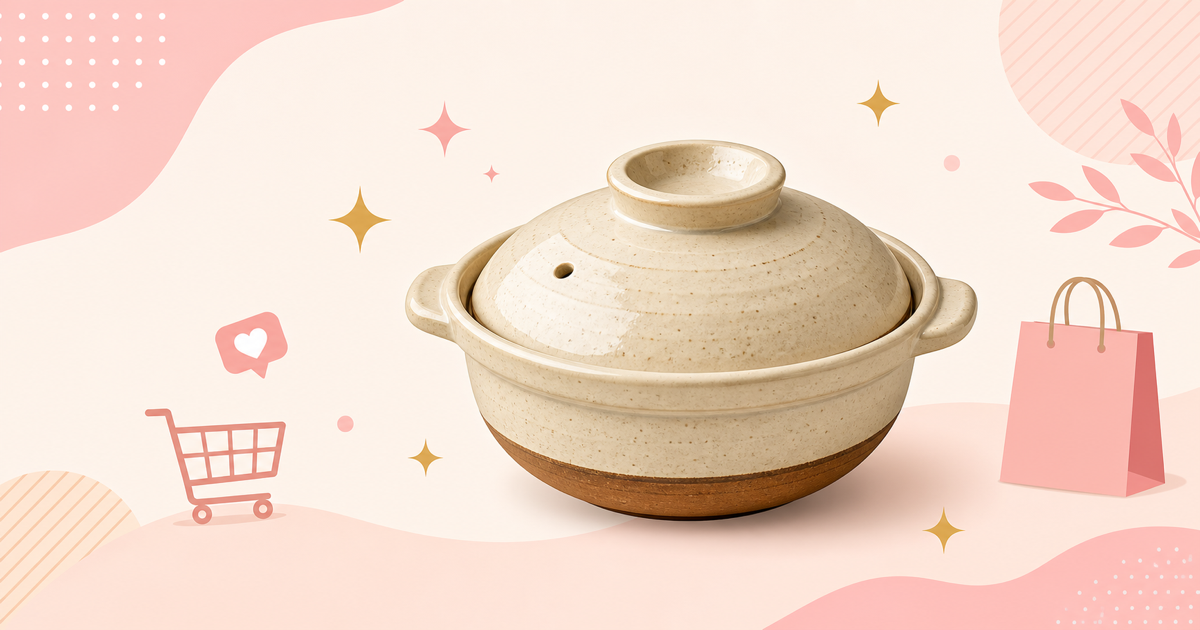

What to Know Before Buying a Donabe
Donabe (Japanese clay pots) shine year-round — not just for hot pot season, but for cooking rice and simmered dishes too. Still, once you actually start shopping, questions pile up fast: What does the "size number" even mean? Will it work on my IH cooktop? What's the difference between Banko ware and Iga ware?
Pick the wrong size and ingredients overflow or cook unevenly. Skip checking heat-source compatibility and you might end up with a pot that simply won't work on an IH kitchen. The origin and lid design also affect how well rice cooks and how simmered dishes turn out.
This guide breaks down five key criteria for choosing a donabe without regret, along with concrete ways to tell them apart, then compares six products suited to different needs. Whether you're focused on hot pot, cooking rice, or an IH kitchen, we've summarized recommendations by use case so you can narrow down the right pot for you.
How to Choose a Donabe: 5 Criteria for a Purchase You Won't Regret
1. Choose Size Based on Household Size and Purpose
Donabe sizes are measured in "go" units, with 1 go equal to roughly 3cm. For hot pot use, here's a general guide:
- Living alone: 6–7 go
- Family of 2–3: 8 go
- Family of 4–5 or more: 9 go or larger
Choose a size that leaves 2–3cm of clearance from the rim once ingredients are added — this reduces boil-overs and makes cooking easier. If you're torn between two sizes, go with the larger one.
Rice-cooking donabe, on the other hand, are best chosen by capacity — labeled in "go" of rice — rather than by the size number. Match it to how much rice you typically cook, and many households keep a separate pot dedicated to rice, apart from their hot pot donabe.
2. Origin and Material Affect the Results
Japan's two major donabe-producing regions are Yokkaichi, Mie Prefecture (home of Banko ware) and Iga ware.
- Banko ware: Made from highly heat-resistant clay containing petalite, giving it strong resistance to sudden temperature changes. It's the dominant style with the largest domestic market share, offering a wide range of prices and designs
- Iga ware: Known for excellent heat retention thanks to its coarse clay texture. Because it keeps cooking food with residual heat even after the flame is off, it suits people who want the best possible results for rice and simmered dishes
Ceramic types that don't use traditional clay tend to be less absorbent and easier to maintain, but their heat-retention character differs from traditional clay pots. Choose based on whether you prioritize that classic "earthenware" feel or ease of care.
3. Always Check Heat-Source Compatibility (Direct Flame Only vs. IH Compatible)
Most traditional donabe are designed for direct flame only and can't be heated on an IH cooktop. If you have an IH kitchen, look for a model with a built-in heating plate in the base, or a ceramic donabe specifically rated for IH use.
If you're planning to move, or your home and your parents' place use different cooktop types, choosing a model compatible with both direct flame and IH can save you from having to rebuy later. Always check the listed compatible heat sources before purchasing.
4. Lid Design (Single vs. Double Lid)
Lid design directly affects how the rice turns out and how well heat is retained.
- Double lid: A two-layer lid structure that holds steam pressure more effectively. This helps rice cook up fluffier and reduces boil-overs
- Single lid: The standard, simpler design that's easy to handle. Perfectly adequate for hot pot use
If cooking rice is your priority, go with a double-lid model. For hot pot-focused use, a single lid works just fine.
5. Ease of Care (Whether Seasoning Is Needed, Water Absorption)
Clay donabe generally require an initial seasoning process called "mejime" — simmering rice-rinse water or porridge to seal the tiny pores in the surface. Skipping this step can lead to cracking or lingering odors.
Some low-absorption donabe, such as ceramic models, can be used right out of the box without seasoning. If you'd rather skip the extra step, check the product description for a "no seasoning required" note.
Spec Comparison Table
| Product | Origin/Material | Heat Source | Primary Use |
|---|---|---|---|
| Ginpo Toki Kikka Donabe, Size 9 | Banko ware | Direct flame | Hot pot / rice cooking |
| Nagatani-en Kamado-san, 3-Go | Iga ware | Direct flame | Rice cooking only |
| Hario Glass-Lid Rice Cooker | Clay + heat-resistant glass lid | Direct flame | Rice cooking only |
| Thermatec IH-Compatible Donabe | Ceramic | Direct flame / IH / oven | Hot pot / simmered dishes |
| Banko Ware Fukkura Gohan Nabe, Double Lid | Banko ware | Direct flame | Rice cooking only |
| Pearl Metal IH-Compatible Tabletop Pot | Clay (lightweight design) | Direct flame / IH | Hot pot (tabletop use) |
6 Recommended Donabe Picks
Ginpo Toki Kikka Donabe
A classic donabe made in Mie Prefecture, the home of Banko ware. Featuring a chrysanthemum-inspired design, its heat-retentive Banko clay makes it versatile for everything from hot pot to rice cooking. With a wide range of sizes available, it's easy to pick the right fit for your household.
Strengths
- Versatile enough for both hot pot and rice cooking
- Wide size range to match household size
- Excellent heat retention typical of Banko ware
Considerations
- Direct flame only — not usable on IH cooktops
- Requires seasoning before first use
Best for
Anyone who wants one pot that handles everything from hot pot to rice cooking.🛒 Check the price →
Nagatani-en Kamado-san
A donabe made by Nagatani-en, an Iga ware kiln specializing in rice cooking. Its double-lid structure holds steam pressure, reducing boil-overs while aiming for fluffy results. The process is simple — just cook over medium-high to high heat and turn off — and it can even produce a crispy rice crust (okoge).
Strengths
- Double-lid design helps prevent boil-overs
- Iga ware's excellent heat retention reduces uneven cooking
- Simple process that's easy to master
Considerations
- Dedicated to rice cooking — not suited for hot pot
- The 3-go capacity may be too small for large families
Best for
Small to mid-size households who want the best possible results from donabe rice cooking.🛒 Check the price →
Hario Glass-Lid Rice Cooker
A donabe from heat-resistant glass maker Hario, featuring the unusual design of a glass lid. You can watch the rice cook in real time, and a built-in whistle sounds from the steam pressure, making it easy to know exactly when to turn off the heat.
Strengths
- Lets you watch the rice cook through the lid
- Whistle signals the right moment to turn off the heat
- Easy to use even for first-time donabe rice cookers
Considerations
- The glass lid may be more fragile than a ceramic one
- Dedicated to rice cooking — can't be used for hot pot
Best for
Anyone trying donabe rice cooking for the first time or unsure about judging heat levels.🛒 Check the price →
Thermatec IH-Compatible Donabe
A ceramic donabe compatible with direct flame, IH, and oven use. Its near-zero water absorption means it skips the seasoning process required by traditional clay pots, so you can start using it right after purchase. It also reduces the risk of mold or lingering odors.
Strengths
- Multi-compatible with IH, direct flame, and oven
- No seasoning needed — ready to use right away
- Low absorption makes maintenance easy
Considerations
- As a ceramic pot, its heat-retention feel differs from traditional clay
- Not a dedicated rice-cooking model and lacks a double-lid structure for that purpose
Best for
A top candidate for anyone using an IH kitchen for hot pot or simmered dishes.🛒 Check the price →
Banko Ware Fukkura Gohan Nabe
A rice-cooking-focused donabe made in the Banko ware region, featuring a double-lid design. The two-layer lid helps hold pressure for fluffier results. It's positioned at a more accessible price point among dedicated rice-cooking models, making it a popular choice for those new to donabe rice cooking.
Strengths
- Double-lid design aims for fluffy rice
- More accessible pricing among dedicated rice-cooking models
- Banko ware's heat resistance makes it easy to handle
Considerations
- Dedicated to rice cooking — not suited for hot pot
- Direct flame only, no IH compatibility
Best for
Anyone wanting to start donabe rice cooking without a big investment.🛒 Check the price →
Pearl Metal IH-Compatible Tabletop Pot
A lightweight, easy-to-handle tabletop pot compatible with IH. Its shallow shape suits enjoying hot pot right at the table, and it's lighter and easier to carry than a traditional clay donabe. It's also priced relatively affordably.
Strengths
- Compatible with both IH and direct flame
- Lightweight and easy to handle at the table
- Relatively affordable pricing
Considerations
- The shallow shape isn't suited for rice cooking
- Capacity may be too small for hot pot for a large group
Best for
Individuals or small households looking for a lightweight, IH-compatible hot pot.
Choosing by Use Case
If hot pot is your main focus
A versatile option like the Ginpo Toki Kikka Donabe, which handles both hot pot and rice cooking, is a good fit — or the Thermatec IH-Compatible Donabe if you have an IH kitchen. Prioritize choosing the right size number for your household.
If you want the best possible rice from a donabe
Dedicated rice-cooking models with a double-lid design, like the Nagatani-en Kamado-san or the Banko Ware Fukkura Gohan Nabe, are ideal. Choose the Fukkura Gohan Nabe if you want to keep costs down, or the Iga ware Kamado-san if you want the full authentic experience.
If this is your first time cooking rice in a donabe
The Hario Glass-Lid Rice Cooker lets you watch the rice cook and tells you when to turn off the heat via its whistle, making it a low-anxiety choice for beginners.
If you have an IH kitchen
Direct-flame-only models won't work, so choose between the Thermatec IH-Compatible Donabe and the Pearl Metal IH-Compatible Tabletop Pot. Go with Pearl Metal if you prioritize lightness and price for hot pot use, or Thermatec if you want multi-heat-source versatility and durability.
If you live alone or in a small household
A smaller 6–7 go size, or a compact option like the Pearl Metal tabletop pot, will likely be the easiest to manage.
FAQ
Q. How do I choose the right size donabe?
For hot pot use, base your choice on household size: 6–7 go for living alone, 8 go for a family of 2–3, and 9 go or larger for a family of 4–5. Choosing a size that leaves 2–3cm of clearance from the rim once ingredients are added helps prevent boil-overs. For rice-cooking donabe, choose by the "go" capacity rating instead.
Q. Can I use a donabe on an IH cooktop?
Only products explicitly listed as IH-compatible can be used on an IH cooktop. Most traditional clay donabe are direct-flame only and can't be heated on IH. Always check the listed compatible heat sources before purchasing.
Q. What is "mejime" (seasoning), and is it always necessary?
Mejime is the initial care step of simmering rice-rinse water or porridge to seal the tiny pores in a donabe's surface. Most clay donabe are prone to cracking or absorbing odors if this step is skipped. However, some low-absorption products, such as ceramic ones, are advertised as not requiring it.
Q. What's the difference between Banko ware and Iga ware?
Banko ware uses highly heat-resistant clay, making it durable against sudden temperature changes and easy to handle day to day. Iga ware is known for its high heat retention from coarse clay, continuing to cook food with residual heat even after the flame is off. For everyday convenience, Banko ware is a good fit; for the best results in rice cooking and simmered dishes, Iga ware is preferable.
Q. Are there any tips for making a donabe last longer?
The basics are drying it thoroughly after use and storing it without leftover moisture. Also avoid exposing a hot donabe to sudden temperature changes, such as dunking it in cold water right after cooking, as this can cause cracking.
Conclusion
Keeping five criteria in mind — size (go number), origin/material, heat-source compatibility, lid design, and ease of care — will help you avoid a donabe purchase you regret.
- For one pot that handles both hot pot and rice cooking: the Ginpo Toki Kikka Donabe
- For the best possible rice: the Nagatani-en Kamado-san or the Banko Ware Fukkura Gohan Nabe
- For your first time cooking rice in a donabe: the Hario Glass-Lid Rice Cooker
- For an IH kitchen: the Thermatec IH-Compatible Donabe or the Pearl Metal Tabletop Pot
Prioritize the criteria that matter most for how you'll actually use it, and pick the pot that fits your everyday table.


![[2026 Latest] Top 5 Yogurt Maker Rankings|Complete Comparison Guide](/images/eyecatch/articles/yogurt-maker-ranking-top5.png)
![[2026 Latest] Top 5 Bento Box Rankings|A Thorough Comparison](/images/eyecatch/articles/bento-box-recommended-ranking-top5.png)
![[2026 Latest] Cutting Board Comparison: A Thorough Test of Wood, Plastic, and Antibacterial Materials](/images/eyecatch/articles/cutting-board-comparison-2026.png)
![[2026 Latest] Best Electric Kettles Compared — Which One Should You Buy?](/images/eyecatch/articles/electric-kettle-ranking-comparison-2026.png)