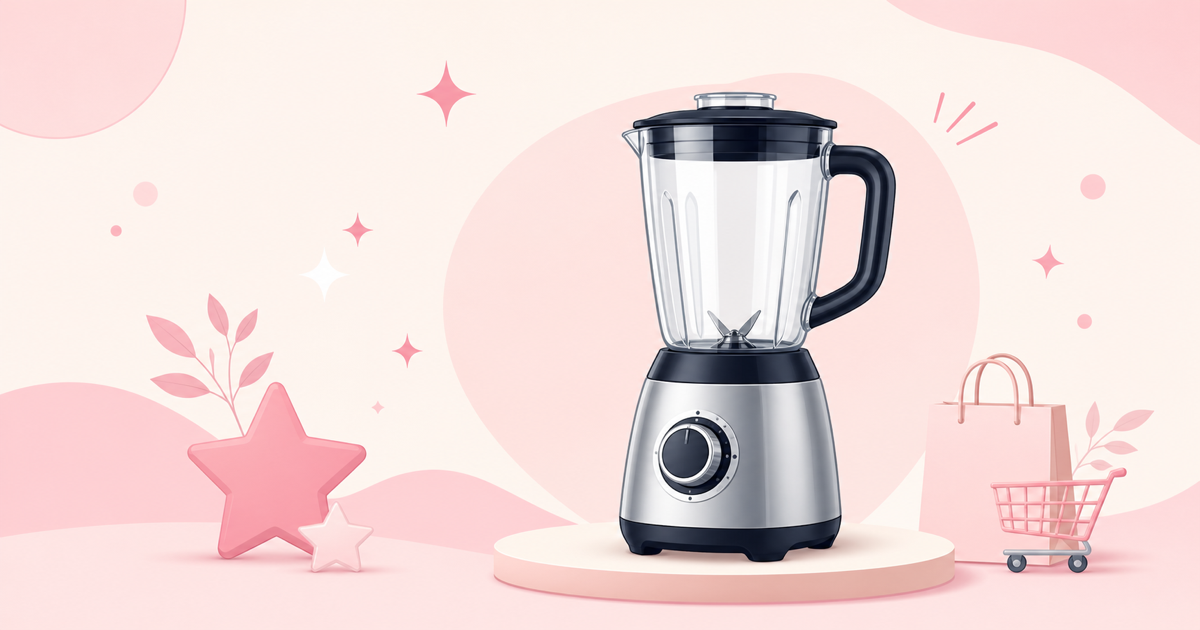

The Classic "Bought It, Never Used It" Appliance: The Blender
Morning smoothies. Pureed baby food. Turning a pot of soup into velvety bisque right in the pan. On paper, a blender sounds like the kind of appliance that transforms your daily routine. In reality, it's also a regular on the list of gadgets that end up gathering dust under the sink within six months of purchase.
The reason is clear. Most people choose based on power (wattage) alone, and underestimate the hassle of cleaning, the noise level, and the batch size they actually need. A large 1.5L glass jar won't spin properly for a single cup of smoothie, and washing it eats up three minutes every morning. On the flip side, buying an underpowered model when you actually want to crush frozen fruit or nuts means the blades spin uselessly and you end up adding water just to get things moving. Blender shopping mistakes rarely come down to weak performance — they come down to a mismatch between the type of blender and how you actually plan to use it.
This article walks through the structural differences between countertop blenders and hand (immersion) blenders, breaks down four decision criteria — wattage, capacity, blade design, and ease of cleaning — and compares seven widely available models with honest pros and cons for each. By the end, you should have a clear picture of exactly which type and model is right for you.
---
How to Choose a Blender: 4 Criteria That Prevent Buyer's Remorse
1. Countertop or Hand Blender? It Comes Down to Where You'll Use It
The first decision isn't about wattage — it's about type. Both appliances spin blades, but the tasks they're built for are fundamentally different.
| Type | Strengths | Weaknesses |
|---|---|---|
| Countertop blender | Crushing frozen fruit, ice, and nuts; making larger batches of smoothies | Small batches, cooking directly in a pot, storage space |
| Hand (immersion) blender | Pureeing soup directly in the pot, small batches of baby food, whipping | Hard frozen ingredients, processing large volumes at once |
The rule of thumb is simple: if you pour what you make into a cup or bowl to eat or drink, go countertop; if you use it mid-cooking, go hand blender. Someone who wants to build a daily smoothie habit but buys a hand blender for its easy cleanup often regrets it the first time frozen fruit refuses to break down.
2. Wattage: The Threshold Depends on Whether You're Blending Frozen Ingredients
Wattage is a rough proxy for motor strength. If you're just blending room-temperature vegetables, fruit, and yogurt, a 200–400W model will get you a smooth result. The real test is ice, frozen fruit, nuts, and fibrous leafy greens.
- Mostly room-temperature ingredients, baby food, soups: 200–400W class is enough
- Ice or frozen fruit as a daily habit: aim for 600W or more
- Nut butters, frozen drinks, a texture with no fiber left at all: high-power models above 1000W
One thing people often overlook is RPM (rotation speed), which usually gets discussed alongside wattage. Even at the same wattage, a higher-RPM model breaks ingredients down more finely, which changes the mouthfeel. Products advertised as "crushes ice even though it's cheap" usually do crush it — but often leave noticeable chunks, so it's worth calibrating your expectations accordingly.
3. Capacity: Choose Based on "Batch Size × 1.5"
A countertop blender jar isn't meant to be filled to its printed capacity and run. It needs empty space to form a vortex, so treat the practical capacity as roughly 60–70% of the listed volume. A 1.0L jar effectively gives you 600–700ml — about two cups.
At the same time, an oversized jar causes its own problems. If ingredients can't reach the blades, they'll spin without making contact, so making a single serving in a large-capacity machine often gives poor results. As a practical guideline: around 1.0L for one or two people, 1.4L or more if you're making batches for the whole family. Bottle-style blenders trade capacity for the ability to drink straight from the container, making them well suited to single servings.
4. Ease of Cleaning Determines Whether You'll Keep Using It
This is the single biggest factor in whether a blender survives past the honeymoon phase. Check these three things:
- Removable blades vs. a fixed unit: fixed units are easier to wash overall but harder to clean in the gaps around the blade
- Dishwasher-safe parts: even just having the parts go in the dishwasher makes a huge difference to your morning workload
- Self-cleaning function: add water and dish soap, run for a few dozen seconds, and the interior rinses itself — essentially a must-have feature for countertop models
Noise is also worth checking. Higher-power models tend to run louder, so if you live in an apartment and plan to use it early in the morning, you'll need to pick either a model powerful enough to finish quickly or one specifically designed to run quietly.
---
Spec Comparison Table
| Product | Type | Power Class | Capacity / Notable Features |
|---|---|---|---|
| Vitamix E310 Explorian Blender | Countertop | High-power (over 1000W) | About 1.4L, 10-speed control plus pulse |
| Blendtec Total Classic Blender | Countertop | High-power (over 1000W) | Square jar, built-in automatic programs |
| Braun MultiQuick Hand Blender MQ775 | Hand | Mid-to-high power | Multi-speed control, includes chopper and other attachments |
| Panasonic Fiber Mixer MX-X701 | Countertop | Mid power | About 1.0L, designed with fiber retention in mind |
| TESCOM Ice-Crushing Mixer TM8200 | Countertop | Mid power | Large-capacity jar, ice-ready stainless blades |
| T-fal Mix & Drink Blender | Bottle-style | Low-to-mid power | All-in-one bottle you can drink straight from |
| Cuisinart Hand Blender HB-155WJ | Hand | Mid power | Compact, attachment-based system |
*Power class is a relative positioning guide for each model, not a precise spec comparison.
---
Top 7 Blender Picks
1. Vitamix E310 Explorian Blender
This is the home-use entry model from Vitamix, a brand with a long track record in commercial-grade blenders. Its motor exceeds 1000W and spins at high speed, designed to smoothly process everything from frozen fruit and nuts to fibrous leafy greens. It offers 10-speed control plus a pulse function, letting you dial in anything from a rough chop to a fully liquefied texture. It also supports self-cleaning — just add water and soap to the jar and run it.
Pros
- Powerful enough to handle frozen fruit and even nut butters
- Fine-grained speed control lets you dial in everything from salsa to soup
- Long manufacturer warranty supports long-term use
Cons
- Its size and height mean it may not fit under wall cabinets in some kitchens
- The high power comes with noticeably loud operation, so early-morning use requires some consideration
Best for: Anyone building a daily smoothie habit who won't compromise on smoothness, and who's willing to treat the long warranty as an investment in a "buy it for life" appliance.🛒 Check the price →
2. Blendtec Total Classic Blender
Alongside Vitamix, this is one of North America's leading high-power blender brands. Its standout feature is the square-shaped jar. The corners create turbulence that pushes ingredients back toward the center vortex, so everything blends evenly in fewer cycles. It comes with automatic programs selectable via buttons or touch controls, letting it process smoothies or soups at a consistent time and speed every time.
Pros
- Automatic programs make it easy to reproduce the same result every time
- The square jar's wide corners are easy to reach with a sponge when washing
- A long warranty adds peace of mind despite the higher price point
Cons
- The distinctive jar shape means compatibility with non-proprietary accessories is limited
- The operating noise is loud, so it's not ideal if quiet operation is your top priority
Best for: Anyone who wants a one-touch experience with no thinking involved. It suits households that prioritize consistent results no matter who in the family is using it.🛒 Check the price →
3. Braun MultiQuick Hand Blender MQ775
This is something of a benchmark model in the hand blender category. The bell-shaped guard at the tip of the shaft is designed to minimize splatter, so you can puree pumpkin or potato soup directly in the pot. Speed adjusts based on how hard you squeeze the trigger, so the same unit handles everything from delicate small batches of baby food to larger pots of soup. It comes with attachments like a chopper and whisk, covering chopping, mixing, and whipping in a single tool.
Pros
- Working directly in the pot eliminates the risk and mess of transferring hot soup
- Main parts are dishwasher-safe, keeping day-to-day maintenance light
- Attachments extend it to fine chopping and whipping cream
Cons
- Not built for crushing hard frozen fruit or ice, so it can't replace a countertop blender
- More attachments means it takes up more storage space than you might expect
Best for: Anyone focused on making baby food right now, or who regularly makes soups and homemade sauces. If you need a tool for "mid-cooking" use rather than making drinks, this should be your top pick.🛒 Check the price →
4. Panasonic Fiber Mixer MX-X701
True to its origin as a Japanese-made appliance, this countertop blender is designed around Japanese ingredients and usage habits. As the name suggests, it's built around the concept of blending that preserves dietary fiber, aiming to reduce the gritty fiber texture in skin-on smoothies while retaining nutrients. At around 1L capacity, it's a comfortable size for making smoothies or dressings for one or two people.
Pros
- As a domestic brand, repairs, parts, and customer support are easy to access
- The roughly 1L capacity suits Japanese kitchens and smaller households well
- Comes with thorough Japanese-language instructions and recipe information
Cons
- Output falls short of high-power overseas models, so hard frozen ingredients may need to be partially thawed first
- The jar is fairly large, so you'll need dedicated counter space to leave it out
Best for: Anyone who values domestic support, or who wants to make a habit of vegetable smoothies that include skins and fiber. A good fit for people who prioritize ease of use over raw power.🛒 Check the price →
5. TESCOM Ice-Crushing Mixer TM8200
This is an entry-level model for anyone who wants to try out owning a blender before committing further. Its stainless steel blades can crush ice, so it also handles frozen drinks and shaved-ice-style desserts. The jar is on the larger side, making it suitable for batch-making smoothies or juice for the whole family. Despite its entry-level price point, it covers all the essential functions you'd expect from a countertop blender.
Pros
- Low upfront cost, making it easy to test whether a blender habit will actually stick
- The larger jar lets you make multiple servings at once
- Simple controls that anyone in the family can use without confusion
Cons
- Compared to high-power models, fibers and seeds tend to leave more noticeable texture
- Continuous run time is limited, so it's not suited to long uninterrupted blending
Best for: Anyone looking for their first blender, or who wants ice-crushing capability without spending a lot. Ideal as a "trial" purchase when you're not yet sure how often you'll actually use it.🛒 Check the price →
6. T-fal Mix & Drink Blender
This is a bottle-style blender that you can carry away and drink straight from once it's done. Unlike a countertop blender, there's no step of pouring the result into a separate cup, so the only things you need to wash are the bottle and the blade. It's built entirely around the use case of making a single smoothie or protein shake every morning, and the compact body is easy to keep permanently on a corner of the counter.
Pros
- No transferring required, minimizing both prep time and dishes in the morning
- The compact body doesn't take up much counter space even left out permanently
- A simple, single-purpose design with straightforward controls
Cons
- The small capacity isn't suited to making batches for the whole family
- Output is modest, so hard frozen fruit may need to be cut into smaller pieces first
Best for: Anyone making a single serving every day who wants minimal time and effort. If you're planning to take it to work or the gym, this is the lowest-friction option available.🛒 Check the price →
7. Cuisinart Hand Blender HB-155WJ
This is a home-use hand blender from a U.S. brand best known for commercial kitchen equipment. Its slim shaft makes it easy to maneuver in narrow pots or measuring cups, and swappable attachments let it handle mixing, chopping, and whipping. It's built at a size that's easy to manage even among hand blenders, and it's practical to store as well.
Pros
- Lightweight and slim, so one-handed operation is comfortable for small-batch tasks
- Fits in a drawer, keeping storage requirements low
- Solid build quality backed by the brand's track record in cookware
Cons
- Not built for large-volume processing or crushing ice the way a countertop model is
- Attachment sets vary by model, so check that the functions you need are actually included
Best for: Anyone who wants the lightest, most storage-friendly hand blender option. More than capable if your main use case is soups or dressings for one or two people.
---
Which Blender Fits Your Needs?
First-time buyer, or unsure how often you'll use it
Start with an entry-level countertop model like the TESCOM Ice-Crushing Mixer TM8200. The low upfront cost keeps your losses small if the habit doesn't stick, and whatever frustrations come up — noise, capacity, blending power — become the criteria for your next purchase.
Serious about a daily smoothie habit
It's between the Vitamix E310 Explorian Blender and the Blendtec Total Classic Blender. Choose Vitamix if you want fine control over the final texture; choose Blendtec if you'd rather press one button and stop thinking about it. Both are designed around long-term use backed by long warranties, and the cost per use drops the more you use them daily.
Mainly for baby food, soft diets, or soups
The Braun MultiQuick Hand Blender MQ775 is the strongest choice. The experience of finishing everything directly in the pot simply can't be replicated by a countertop blender. If your cooking is mostly small-batch and you prioritize lightness, the Cuisinart Hand Blender HB-155WJ is also worth considering.
Making a single serving every morning, as fast as possible
The T-fal Mix & Drink Blender. Fewer dishes to wash translates directly into a habit you'll actually keep.
Prioritizing domestic support and ease of use
The Panasonic Fiber Mixer MX-X701 strikes a good balance between Japanese-language support, repair infrastructure, and a size that suits Japanese kitchens.
Note that countertop blenders and hand blenders aren't really competitors. Owning both — a countertop model for smoothies and a hand blender for cooking — is a reasonable setup that cancels out each type's weaknesses. Splitting your budget between the two is often worth it.
---
FAQ
Q. What's the difference between a blender, a mixer, and a food processor?
In everyday use, "blender" and "mixer" are treated as essentially the same thing — a machine that blends ingredients (usually including liquid) into a smooth mixture. A food processor, by contrast, is built for chopping, kneading, and mixing ingredients with little moisture; it excels at fine chopping or kneading dough but isn't suited to liquefying something like a smoothie. As a rule of thumb: if what you're making is meant to be sipped or drunk, go with a blender; if it's meant to be chopped or kneaded, go with a food processor.
Q. Can every model crush ice or frozen fruit?
No. You need to specifically choose a model labeled as ice-compatible. Putting ice into a non-compatible machine can chip the blades or overload the motor, leading to breakdowns. Even with a compatible model, it's best to cut frozen fruit into smaller pieces or let it thaw slightly rather than adding it in large frozen chunks — this improves both the final texture and reduces strain on the machine.
Q. How much maintenance does a blender actually require?
For countertop models, adding a small amount of water and dish soap to the jar and running it briefly right after use — self-cleaning — removes most everyday residue. The real problem comes after things dry: residue hardens around the base of the blades over time. Rinsing immediately after use is the habit that makes or breaks long-term maintenance. Hand blenders just need the shaft detached and washed, and dishwasher-safe models cut the effort down even further.
Q. I live in an apartment — will morning use be a noise problem?
Higher-power models do tend to run louder. There are two practical countermeasures. One is to finish quickly — more powerful models often complete a blend in 30–60 seconds, so the total noise duration can actually end up shorter. The other is placing an anti-vibration mat underneath to reduce vibration transfer. If you're still concerned, choosing a lower-power type like a bottle-style or hand blender is the safest bet.
Q. How long does a blender typically last?
This depends heavily on usage frequency and habits, but the parts that wear out most are the motor, blades, and gaskets. In particular, respecting the maximum continuous run time has a direct impact on lifespan. If the manual specifies a maximum run time and you regularly exceed it, motor degradation accelerates significantly. Since blades and gaskets are often sold as replacement parts, checking parts availability before purchase can help you use the blender for longer.
Q. I might not use it every day — is it still worth buying?
If you're not sure how often you'll use it, it's more sensible to start with an entry-level model, or a hand blender or bottle-style model that's easy to store. High-performance machines offer good value "for people who use them daily" — for once-a-week use, they're overkill. Whether you can leave it out on the counter is the single biggest factor determining how often you'll actually use it, so think about where it will live before you think about specs.
---
Summary
The smartest way to choose a blender isn't to chase raw power — it's to work through these criteria in order.
Here's the recommendation breakdown by reader type, one more time:
- First blender: TESCOM Ice-Crushing Mixer TM8200
- Serious daily smoothie habit: Vitamix E310 Explorian Blender (for fine control) / Blendtec Total Classic Blender (for one-touch simplicity)
- Mainly baby food and soups: Braun MultiQuick Hand Blender MQ775
- Lightweight, storage-friendly hand blender: Cuisinart Hand Blender HB-155WJ
- Fastest single-serving option: T-fal Mix & Drink Blender
- Prioritizing domestic support: Panasonic Fiber Mixer MX-X701
The number one reason blenders end up unused isn't weak performance — it's the hassle of getting it out and the hassle of washing it. Decide where it will live in your kitchen before you look at the spec sheet. That's the surest way to avoid buyer's remorse.


![[2026 Latest] Top 5 Yogurt Maker Rankings|Complete Comparison Guide](/images/eyecatch/articles/yogurt-maker-ranking-top5.png)
![[2026 Latest] Top 5 Bento Box Rankings|A Thorough Comparison](/images/eyecatch/articles/bento-box-recommended-ranking-top5.png)
![[2026 Latest] Cutting Board Comparison: A Thorough Test of Wood, Plastic, and Antibacterial Materials](/images/eyecatch/articles/cutting-board-comparison-2026.png)
![[2026 Latest] Best Electric Kettles Compared — Which One Should You Buy?](/images/eyecatch/articles/electric-kettle-ranking-comparison-2026.png)