

Ever run into these mechanical pencil frustrations?
You're in the middle of an exam, pen racing across the answer sheet, when—snap—the lead breaks. Those few seconds spent clicking for more lead only make the panic worse. Or maybe during long note-taking sessions or desk work, the base of your gripping fingers starts to ache.
Much of this frustration comes down to picking a cheap mechanical pencil without much thought. In reality, mechanical pencils differ significantly in design—lead-protection mechanisms, grip shape, center-of-gravity balance—all of which shape the writing experience. Even with the same 0.5mm lead, how easily it breaks and how tired your hand gets can vary enormously depending on the mechanism.
This article compares seven staple models favored for drafting, exam prep, and everyday business use, focusing on their mechanisms and specs. Use it as a guide to find the one that matches your writing style.
How to Choose a Mechanical Pencil | 4 Criteria for Avoiding a Bad Pick
Does it have a lead-break prevention mechanism?
This matters most for people with heavy hand pressure or who write quickly. There are two main approaches to preventing lead breakage.
- Lead-protecting structures (e.g., Delguard) — the moment pressure hits the tip, a pipe or spring wraps around the lead and redirects the force before it breaks
- Lead-retracting structures (e.g., Orenz Nero) — when pressure is applied, the tip retreats into the body, reducing the impact on the lead itself
Both achieve "resistance to pressure," but because the mechanisms differ, the firmness of the writing feel and how often you need to click also differ.
Auto-rotating lead for a consistently sharp point
With an ordinary mechanical pencil, only one side of the lead wears down during writing, gradually producing a thicker line. Models with the Kurutoga mechanism rotate the lead slightly with each stroke, keeping it in a consistently sharp, cone-like point. This is a noticeable benefit for anyone who wants neat handwriting or a consistently thin line.
Grip shape and center-of-gravity balance
Rubber grips, knurled (metal non-slip grooves), and movable grips all feel very different depending on material and shape. In particular, check these in the spec sheet:
- Weight (lighter models are less tiring for long writing sessions; heavier models offer more stability for straight lines like drafting)
- Grip diameter (thicker grips distribute pressure and reduce fatigue, but make fine control harder)
- Center of gravity (tip-weighted suits drafting; center-weighted is more versatile for general use)
Lead diameter and body rigidity suited to your use case
0.3mm suits fine writing but breaks easily; 0.5mm is the most versatile. 0.7mm and above suit drafting or writing in bold strokes. For drafting, whether the body is metal or resin also affects the stability of straight lines, so that's worth checking too.
Spec Comparison Table
| Product | Lead-break Prevention | Lead Rotation | Body Material / Weight |
|---|---|---|---|
| Pentel Orenz Nero | Auto lead feed (retracting) | None | Metal parts, slightly heavy |
| Mitsubishi Pencil Kurutoga Dive | Dive mechanism (shock absorbing) | Kurutoga mechanism | Mainly resin, lightweight |
| Pentel Graphgear 1000 | None (designed for thick drafting lead) | None | Metal body, substantial weight |
| Staedtler 925 25 | None (stable via knurled grip) | None | Metal body, substantial weight |
| Zebra Delguard | Double-guard structure | None | Mainly resin, standard |
| Mitsubishi Pencil Uni Kurutoga Advance | Lead-protection mechanism | Kurutoga mechanism | Mainly resin, standard |
| Pilot Dr. Grip | None | None | Rubber grip, lightweight design |
7 Recommended Mechanical Pencils
Pentel Orenz Nero
This model features an automatic lead-feed mechanism that lets you keep writing without clicking. Lead is fed out gradually with each stroke from a retracted position inside the body, so it rarely gets short enough to become breakage-prone. The metal-part body also gives it a premium feel.
Pros
- Almost no need to click for more lead
- Retracting design resists breakage
- Premium feel from metal components
Cons
- The complex lead-feed mechanism pushes it into a higher price bracket than entry-level models
- Its weight may not suit those who prioritize lightness
Best for
Anyone who wants to reduce clicking during long exams or study sessions, and anyone tired of lead-break stress.🛒 Check the price →
Mitsubishi Pencil Kurutoga Dive
This model combines the Kurutoga mechanism—which rotates the lead slightly with each stroke to keep it sharp—with a Dive mechanism that absorbs shock at the tip. Letters are less likely to become rounded, making it well-suited for those who want to keep their notes looking neat.
Pros
- Auto-rotating lead helps keep line thickness consistent
- Shock-absorbing mechanism reduces the risk of breakage
- Lightweight resin body, easy to handle over long writing sessions
Cons
- Feels less rigid than metal-bodied models
- Less suited to uses requiring the stability of straight lines, like drafting
Best for
Students who want to keep their notes neat, and anyone who writes a lot on a daily basis.🛒 Check the price →
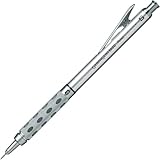
Pentel Graphgear 1000
A staple drafting mechanical pencil. Its metal body's weight contributes to stability when drawing straight lines. The knock section doubles as a movable grip, which can be adjusted to fit your hand size and grip style.
Pros
- Stable writing feel from its metal body
- Movable grip allows flexibility in how you hold it
- As a long-standing staple, replacement leads and parts are easy to find
Cons
- No lead-break prevention mechanism, so it's not ideal for fast writing with heavy pressure
- Its weight may feel unfamiliar to those used to lighter models
Best for
Anyone who prioritizes stability of straight lines above all, such as for drafting or technical drawing.🛒 Check the price →
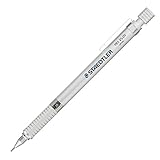
Staedtler 925 25
A precision-engineered model from a long-established German brand. The metal grip's knurled (finely grooved) surface resists slipping even in sweaty or humid conditions. It's built to be sturdy enough for long drafting sessions.
Pros
- Reliable grip from the knurled surface
- Durable metal body suited to long-term use
- Center-of-gravity balance well-suited to drafting work
Cons
- The knurled texture can leave marks on fingers after prolonged bare-hand use
- May feel heavy to those accustomed to lighter pens
Best for
Anyone doing extended drafting or design work, or who values durability as a tool.🛒 Check the price →
Zebra Delguard
This model uses a double-guard structure to protect the lead. The moment strong pressure is applied, a pipe and spring work together to distribute the load, making it resistant to breakage even for those with a habit of pressing hard.
Pros
- Double-guard structure withstands strong writing pressure
- Lightweight resin body that's easy to handle
- Simple operation suitable for both children and adults
Cons
- No lead-rotation mechanism, so line consistency lags behind other models
- Lacks the premium feel of metal-bodied models
Best for
Those with heavy hand pressure, and parents choosing a pencil for a child's studies.🛒 Check the price →
Mitsubishi Pencil Uni Kurutoga Advance
This model combines the Kurutoga mechanism's automatic lead rotation with a lead-protection mechanism. It uses a non-slip grip material, making it a good fit for anyone who wants both a consistently sharp point and resistance to breakage.
Pros
- Combines lead-rotation and lead-protection mechanisms
- Non-slip grip for stable writing
- Positioned as a step up in spec from the Kurutoga Dive
Cons
- The added mechanisms can make the body feel a bit thicker
- Less weight and rigidity than dedicated drafting models
Best for
Students and professionals who want both a consistently sharp point and resistance to breakage.🛒 Check the price →
Pilot Dr. Grip
This model is defined by its ergonomically designed grip. The thick rubber grip is designed to distribute pressure across the fingers, aiming to reduce hand fatigue during long writing sessions.
Pros
- Thick grip helps distribute writing pressure
- Lightweight design suited to long writing sessions
- Wide range of color options to choose from
Cons
- No lead-break prevention or lead-rotation mechanism
- The thick grip may not suit those who prioritize fine control
Best for
Anyone who wants to reduce hand fatigue during long note-taking or desk work sessions.
Choosing by Use Case
- For exam prep and qualification studying — choose "Pentel Orenz Nero" to reduce clicking, or "Mitsubishi Pencil Kurutoga Dive" / "Mitsubishi Pencil Uni Kurutoga Advance" to keep your handwriting neat
- Mainly for drafting and design work — choose "Pentel Graphgear 1000" for stable straight lines, or "Staedtler 925 25" for durability and precision
- For heavy hand pressure or fast writing — choose "Zebra Delguard" for reduced lead breakage
- For hand fatigue during long writing sessions — choose "Pilot Dr. Grip" for grip comfort
- Unsure which to choose first — "Zebra Delguard" or "Mitsubishi Pencil Kurutoga Dive" offer an easy-to-use balance of breakage resistance and usability
FAQ
Q. Why does mechanical pencil lead break so easily?
The two main causes are pressure concentrating at the tip of the lead, and the lead becoming unstable as it gets shorter and loses support. Models with lead-break prevention mechanisms distribute or absorb this force, making them more resistant to breakage. If you know you write with heavy pressure, it's worth checking whether a model has this mechanism.
Q. How does the Kurutoga mechanism work?
It converts the up-and-down motion applied to the tip during writing into rotational force via a gear, turning the lead slightly with each stroke. This prevents one side from wearing down and becoming thicker, keeping the point consistently sharp. It suits anyone who wants to keep their handwriting neat.
Q. How should I choose between 0.3mm, 0.5mm, and 0.7mm?
0.3mm produces thin, precise lines but breaks easily, making it suited to advanced users or detailed diagrams. 0.5mm is the standard diameter, versatile for writing, studying, and work in general. 0.7mm and above suit bold notes or situations where breakage resistance is a priority.
Q. Do I need separate pencils for drafting and studying?
It's not strictly necessary, but each purpose favors different features. Drafting benefits from a heavier, metal-bodied model for stable straight lines, while studying and exam prep favor a lightweight model that resists fatigue over long writing sessions, along with a lead-break prevention mechanism.
Q. Does a mechanical pencil need maintenance?
Simply brushing away accumulated graphite dust from inside occasionally is enough to prevent clogging. For metal-bodied models, wiping them down lightly after use helps prevent discoloration from hand sweat and extends their lifespan. No special disassembly or cleaning is generally needed.
Conclusion
When choosing a mechanical pencil, you're less likely to go wrong if you focus on four things: lead-break prevention, lead-rotation mechanism, grip shape, and a lead diameter suited to your use case.
- To skip the hassle of clicking: "Orenz Nero"
- To keep your handwriting neat: "Kurutoga Dive" or "Uni Kurutoga Advance"
- For drafting and straight-line work: "Graphgear 1000" or "Staedtler 925 25"
- For heavy hand pressure: "Delguard"
- To reduce hand fatigue: "Dr. Grip"
Consider your own writing style and use case, and pick the one that matches based on these mechanical differences.




![[2026 Latest] Fountain Pen Comparison Guide [2026 Edition]](/images/eyecatch/articles/fountain-pen-comparison-2026.png)
![[2026 Latest] Best Ballpoint Pens Compared: The Ultimate Ranking](/images/eyecatch/articles/ballpoint-pen-ranking-comparison.png)